Russia's billionaires 2026: Numbers, industries, strategies
More billionaires than ever before: Russia's latest rich list
The Bloomberg Billionaires Index is a daily updated ranking of the world's wealthiest people, based on estimates of assets such as company holdings, stock prices, and public financial data. As of January 25, the ten richest Russian citizens are ranked between 82nd and 297th place. All assets listed have been converted from US dollars to euros at the current exchange rate.
The group is led by Vladimir Potanin, a metals and commodities investor and major shareholder in Norilsk Nickel, with an estimated fortune of €25.2 billion. He is followed by Alexei Mordashov, steel magnate and main shareholder in the Severstal group, with €23.4 billion, Leonid Mikhelson, co-owner of Novatek, with €21.1 billion, Vladimir Lisin, steel and logistics entrepreneur, with €20.6 billion, and Vagit Alekperov, former Lukoil boss and oil magnate, with €20.0 billion.
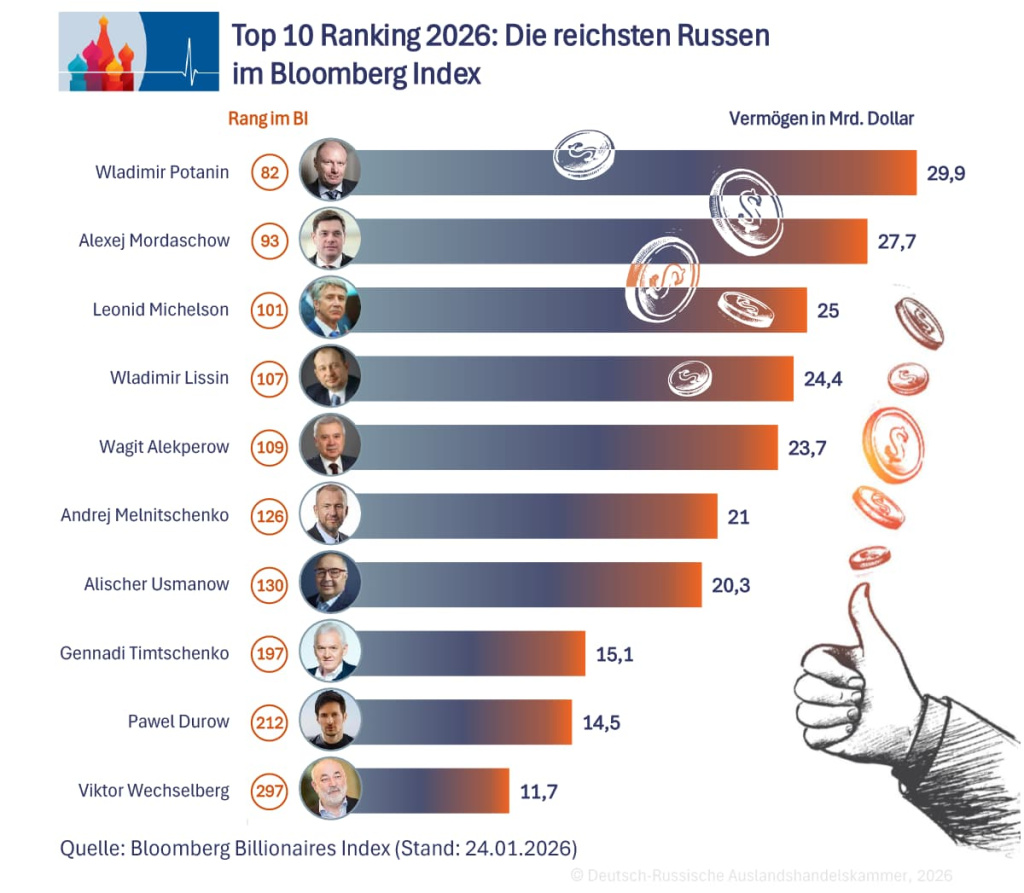
Other listed assets include Andrey Melnichenko, entrepreneur in the fertilizer and energy sector, with €17.7 billion, Alisher Usmanov, metal, telecommunications, and tech investor, with €17.1 billion, Gennady Timchenko, energy and financial investor, with €12.7 billion, Pavel Durov, Telegram founder, with €12.2 billion, and Viktor Vekselberg, founder of the Renova Group, with €9.9 billion.
The sectoral composition of this group is striking. Raw materials, metals, energy, and commodities continue to dominate. The presence of Pavel Durov marks an exception within an otherwise heavily commodity-driven top group.
Another feature of the current snapshot is the development since the beginning of 2026. In the Bloomberg index, not a single one of the listed Russian billionaires has a negative balance. Potanin recorded an increase of around €3.5 billion, Mordashov +€1.5 billion, Mikhelson +€1.3 billion, Lisin +€650 million, Alekperov +€1.1 billion, Usmanov +€1.0 billion, Melnichenko +€2.0 billion, Vekselberg +€1.0 billion.
However, a comparison with the world's richest man puts the Russian gains into perspective: Elon Musk's fortune is currently estimated at around €650 billion, with an increase of around €65 billion since the beginning of the year alone. The gap between Elon Musk and the second-ranked Google founder Larry Page is almost €400 billion – almost as much money as all Russian billionaires combined.
HSE study: Russia's billionaires adapt to sanctions
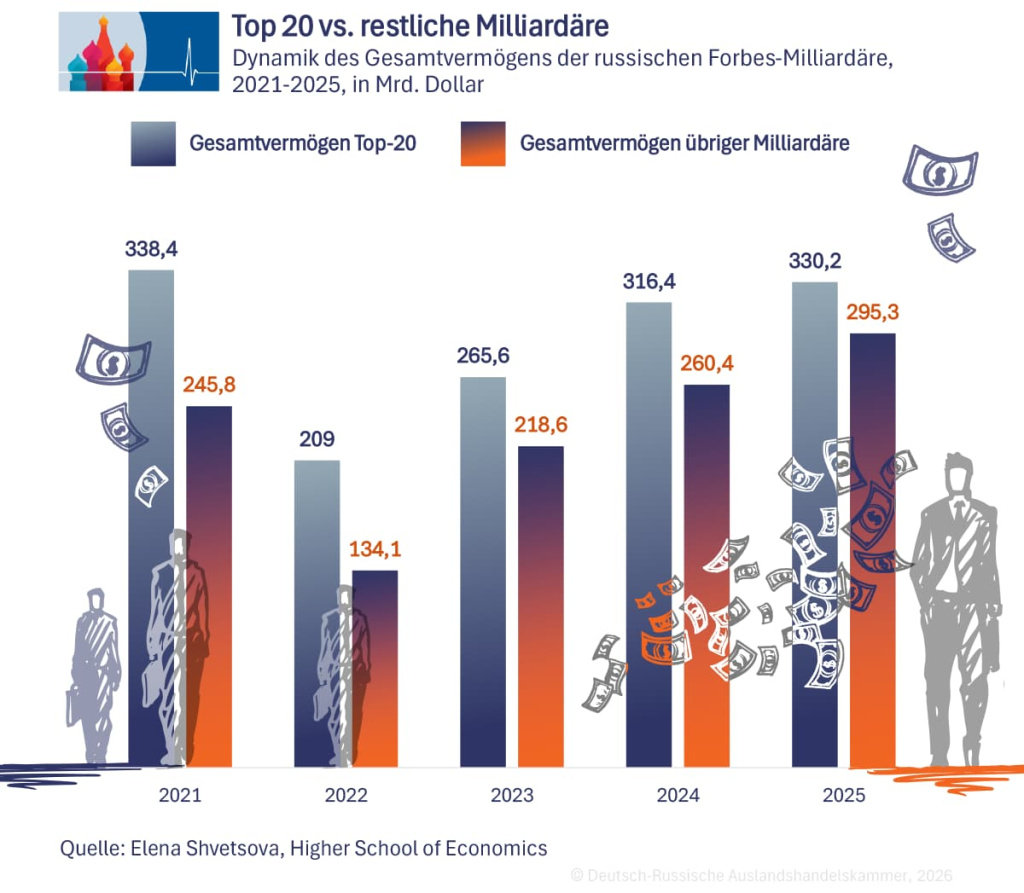
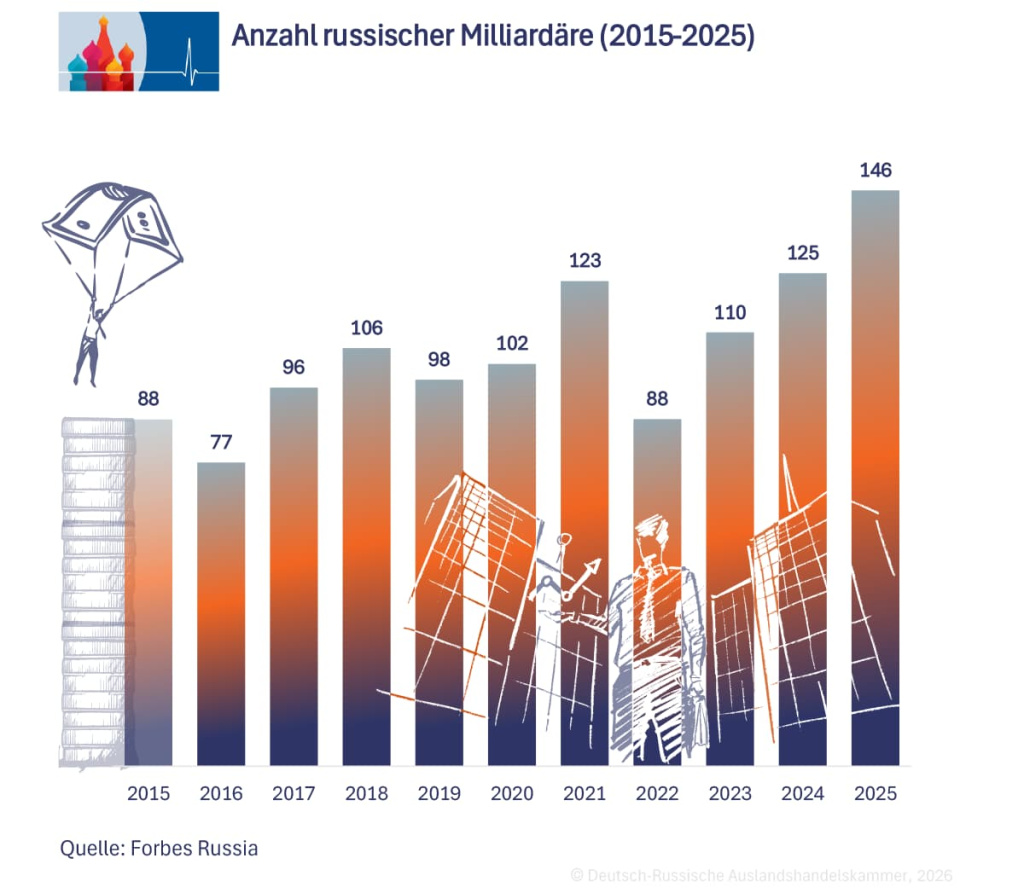
A systematic evaluation of Russian billionaires' reactions to Western sanctions since 2022 is provided in a recent study by Elena A. Shvetsova from the elite Moscow university Higher School of Economics. The study covers the period from February 2022 to January 2025 and is based on the Forbes Russia ranking of the 125 richest businesspeople in 2024. Open sources are supplemented by registry data (SPARK-Interfax).
The key finding of the study is:
"Despite massive sanctions, the core composition of the Russian elite remained remarkably stable: the retention rate in the ranking was 89% between 2022 and 2023, and even 91% from 2023 to 2024. This means that only a few billionaires disappeared permanently from the list – suggesting that the sanctions had little impact on the composition of the elite."
The study quantifies the adjustment strategies of Russian magnates in response to the sanctions. Around 50% of the billionaires surveyed increased their domestic investments. About one-third complicated their ownership and holding structures. Around 25% sold off individual assets. About one-sixth repatriated capital to Russia or divested themselves of foreign assets. A similar proportion acquired assets from Western companies that withdrew from Russia. Foreign acquisitions remained limited, but continued to take place among around 15 to 20% of billionaires.
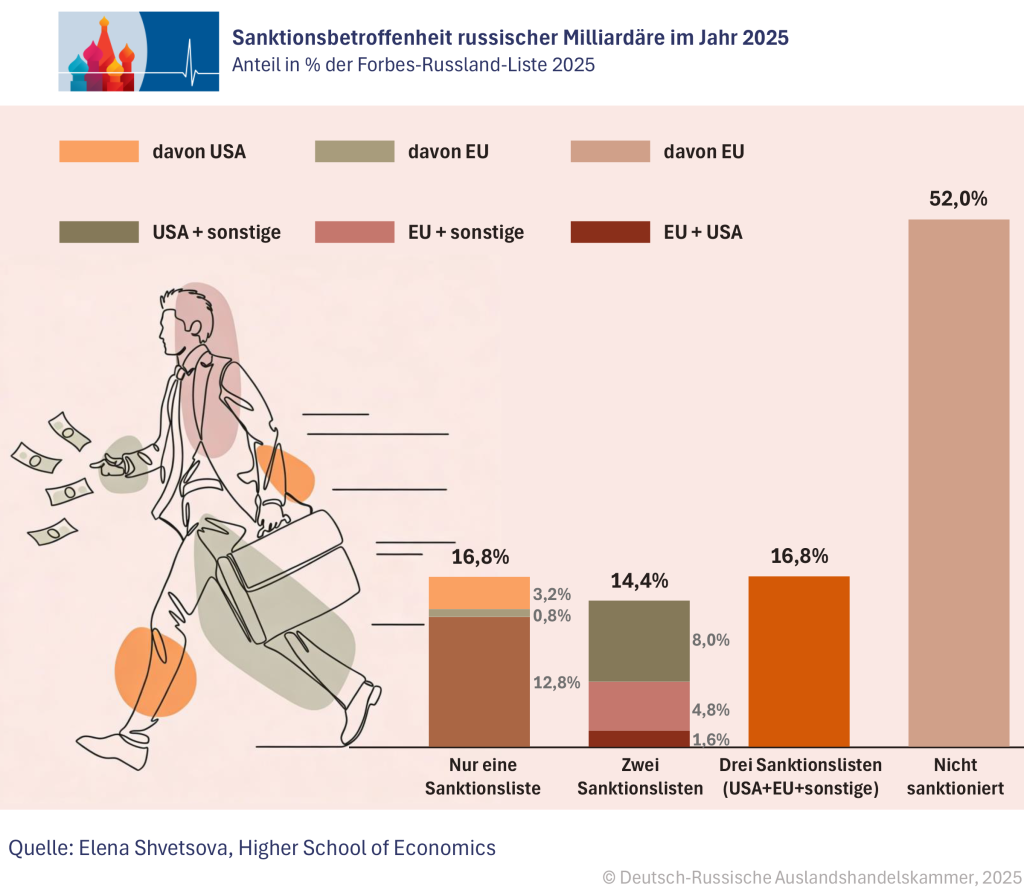
"The top 20 Forbes billionaires were almost unanimously targeted by Western sanctions: since 2022, three-quarters of them have been on Western sanctions lists, while only 42% of the remaining billionaires have been sanctioned. The top 20 were suddenly exposed to sanctions on a large scale, while the remaining billionaires were gradually added to the lists. Nevertheless, this intense persecution has hardly shaken the top positions of the top 20 in Russia – they continued to set the tone domestically."
Shvetsova identifies renouncing Russian citizenship as a rare but analytically relevant adaptation strategy. For the period from 2022 to 2024, she documents ten billionaires who have taken this step. Those who have renounced their Russian citizenship include Timur Turlov, founder of the Freedom Finance financial group, technology investor Yuri Milner, Nikolai Storonsky, founder of the financial services provider Revolut, Oleg Tinkov, founder of Tinkoff Bank, now called T-Bank, and Vladimir Potanin, as well as Vasily Anisimov, a former business partner of Alisher Usmanov. Another is Arkady Volozh, co-founder of the internet company Yandex. The sectoral concentration is striking: seven of the ten cases involve entrepreneurs from IT, financial services, and venture capital. Shvetsova explains this with the "lightness" of their asset structure, the lack of location-bound tangible assets, as well as stronger global integration and less dependence on the Russian state.
In recent years, many Russian billionaires have been forced to make a fundamental strategic decision: either to permanently relocate their assets and business activities abroad, or to bring them back under the supervision of the Kremlin.
Commodities, consumer goods, tech: who won, who lost
Commodities, metals, energy, and fertilizers continue to form the core of the largest fortunes. In the Forbes 2025 ranking, several representatives of these sectors recorded significant growth.
Alisher Usmanov increased his fortune by around $5.3 billion to $18.5 billion, Viktor Vekselberg by around $3.0 billion, and Iskander Makhmudov by around $4.4 billion – all three are key players in the Russian raw materials industry, whose wealth growth is primarily the result of investments in metal, mining, and energy-intensive companies.
There are two drivers: on the one hand, high prices and stable export revenues, and on the other, takeover opportunities in the wake of Western companies pulling out. At the same time, new billionaire fortunes have emerged in domestically oriented sectors such as retail, agriculture, housing construction, and e-commerce.
On the other hand, the losers are sectors that are highly dependent on the West, especially technology and financial services. Here, sanctions are having an impact through restricted access to capital, market foreclosure, talent drain, and more complex regulatory requirements.
Germany vs. Russia: Magnates versus family entrepreneurs
A comparison of billionaires in Germany and Russia reveals clear structural differences in the creation and composition of large fortunes. According to current Forbes data, Germany topped the list of countries with the most billionaires in Europe in 2025 and ranked fourth worldwide with 171 citizens in the ranking, whose cumulative wealth is estimated at around US$793 billion.
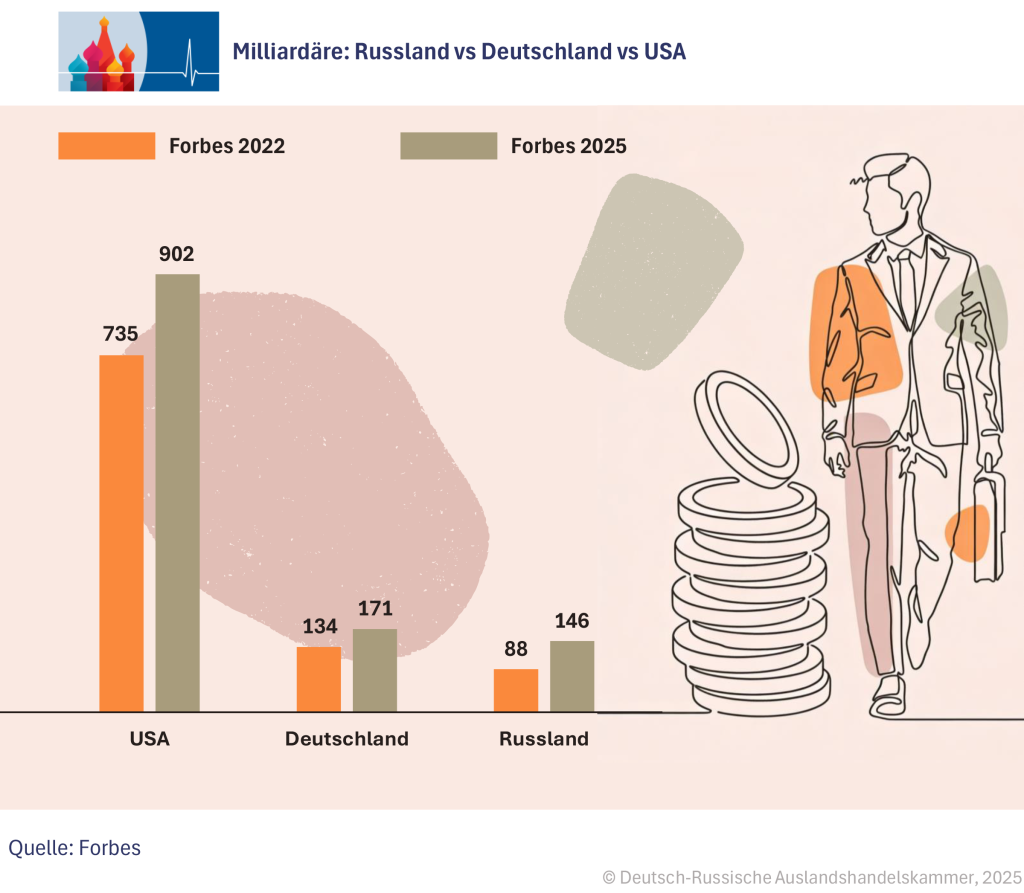
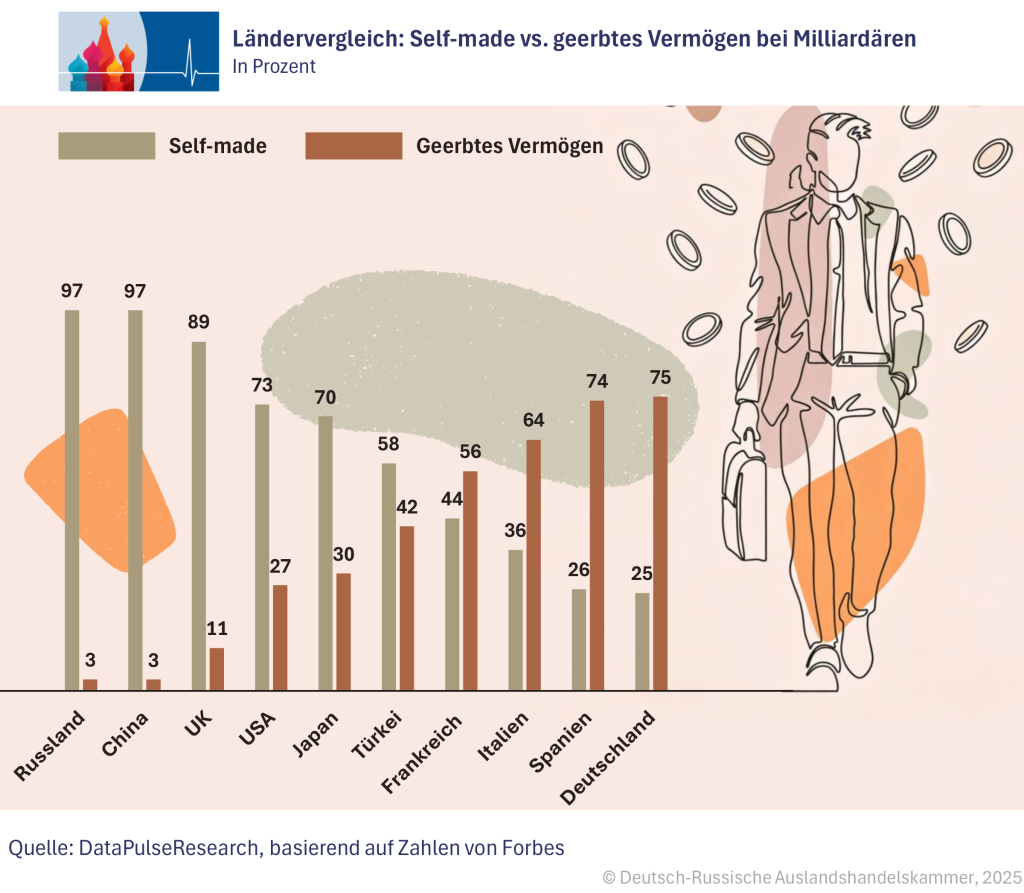
In the German context, family entrepreneurs and heirs to large medium-sized or global corporations dominate the top positions. Family networks and cross-generational ownership structures shape wealth creation: for many of the richest Germans, their wealth is the result of many years of entrepreneurial activity within a family group or the transfer of large company holdings over several generations. Susanne Klatten, for example, is rich thanks to shares in BMW and Altana, which she holds as part of the Quandt family, and is considered "Germany's richest woman." Around 75% of Germany's super-rich have inherited their wealth, according to a data analysis based on Forbes statistics.
In contrast, around 97% of Russian billionaires are classified as self-made, indicating that wealth in Russia has predominantly been created in the recent past through individual business start-ups and expansions, often linked to export-oriented commodity and industrial businesses. This distinguishes the Russian elite from the German elite: while the latter often derives its top positions from long-established family businesses, the Russian billionaire class is predominantly based on assets acquired since the collapse of the Soviet Union.
Another difference can be seen in the ratio of billionaire wealth to economic output. In Germany, the wealth of the richest individuals is estimated to be around 12% to 18% of GDP, indicating a relatively broad capital base that is strongly anchored in productive economic sectors such as industry, trade, and mechanical engineering. In Russia, on the other hand, the wealth of billionaires is estimated to account for around 27% of GDP.
The 1990s and the "golden age" of magnates
In the 1990s, Russia's new wealth elite emerged in an environment of radical privatization, weak institutions, and high political permeability between the state and big capital. Historians and observers point in particular to programs in which strategic state assets were pledged against short-term loans to the state and then acquired at low prices; This process is seen as symbolic of politically influenced wealth creation in the late Yeltsin era. It was during this phase that the term "oligarch" gained its meaning: it refers not only to very wealthy entrepreneurs, but also to a constellation in which wealth and political influence are concentrated at the same time.
Forbes describes the origins of the Russian billionaire class as the result of a "gigantic and brutal redistribution of property" in the 1990s. The profile of the "typical Forbes list character" in the golden 2000s was as follows:
"The authors of the first Forbes ranking in 2004 created a profile of the 'typical Forbes list character': a 47-year-old man, born outside Moscow but with a technical degree from a Moscow university. He traded in computers before moving into banking and commodity exports. He owns a significant stake in a commodity producer and spends much of his life in Europe or North America, where he moved with his family in the late 1990s."
The article goes on to characterize this group as follows:
"They all managed to survive the ruthless struggle of the Russian business world in the 1990s and defend their fortunes at a time when it was not a question of acquiring but of preserving property. They are tough, intelligent, highly rational, and extremely ambitious people who are willing to compromise and can reach agreements with both the authorities and their business partners. This combination of qualities did not guarantee success, but it certainly made it possible."
Forbes refers to the years from 2000 to 2008 as the "golden years." Symbolic of this period is Oleg Deripaska, who in 2008 was, according to Forbes, "the wealthiest Russian and the ninth richest person on the planet, with a fortune of $28 billion." The financial crisis of 2008/2009 ended these "golden years," and Deripaska's fortune is currently only around €4 billion.
The reason why the Russian super-rich are now referred to as "magnates" rather than "oligarchs" has to do with the changed political economy since the 2000s, in which the super-rich may have more money than ever before, but their political influence is only a shadow of what it was in the 1990s.
This article first appeared in the exclusive newsletter of the German-Russian Chamber of Commerce.
This article first appeared in the exclusive newsletter of the German-Russian Chamber of Commerce.