Construction giant Samolet in trouble
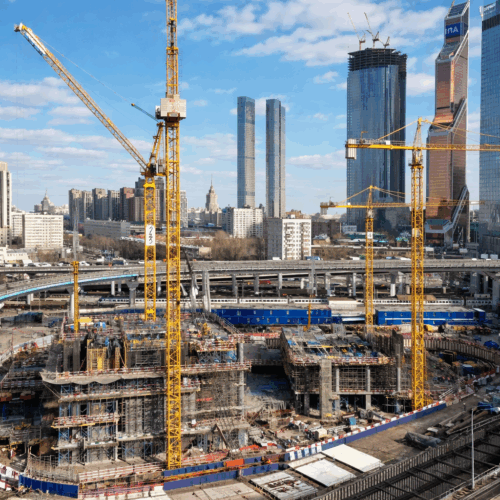
The largest residential developer in Russia in terms of construction volume was long considered the high-flyer among Russian real estate companies. This was entirely in keeping with its name, Samolet, the Russian word for "airplane," which is pronounced "Samaljot."
According to the Russian industry portal ERZ, Samolet is the country's largest residential developer in terms of residential space under construction. As of February 1, the company had a total of 4.72 million square meters under construction in 16 Russian regions, putting it ahead of its biggest competitor, PIK. The developer, also based in Moscow and listed on the Moscow Stock Exchange, had a construction volume of 4.07 million square meters in 14 regions. In terms of revenue, however, PIK, which focuses more on Moscow and the surrounding area, is ahead. In the first half of 2025, it generated 328 billion rubles (3.6 billion euros), almost twice as much as Samolet, which generated 170 billion rubles (1.8 billion euros).
In October 2020, in the midst of the pandemic, Samolet ventured onto the Moscow Stock Exchange. It was the first IPO of a private company after a three-year drought without any significant IPOs in Russia, the Reuters news agency wrote at the end of November 2021. By that point, Samolet's share price had almost quintupled thanks to strong financial results. The company even talked about a possible listing on the New York Stock Exchange in 2023.
Government to help with debt servicing
Now Samolet has taken another step forward: in mid-January 2026, it became the first representative of the struggling construction industry and probably the first large Russian private company in recent years to ask the government for financial assistance. The letter, reported by the Moscow business portal RBC on February 4, mentions a subsidized loan "or other stabilizing instrument" amounting to around 50 billion rubles, equivalent to approximately 540 million euros. According to RBC, the company wrote to Prime Minister Mikhail Mishustin that this would prevent it from being unable to service its liabilities to creditors and investors. In return, it offered the government a stake in the company, for which the company would like to reserve a buyback right, RBC quoted from the letter.
Samolet itself confirmed the request for "state support," as stated in the press release. This is in line with "standard market practice" and "a diversified approach to ensuring the long-term stability of the business." Without the aid, the company would be forced to raise prices for new apartments significantly, Samolet had previously written on its Telegram channel.
On February 9, five days after the first media reports, CFO Nina Golubitschnaja provided investors with details of the request for assistance. She made it clear that, given the high key interest rate, Samolet was hoping for government support in servicing its debt. Instead of paying interest to banks, the company wanted to use its free funds for new projects or to reduce existing liabilities. At the same time, Golubichnaya denied the share transfer to the government offered in the letter. She clarified that the restricted block of shares mentioned in the letter, i.e., at least 25% of the shares, could only be used as collateral to secure the requested loan.
Burden of expensive takeover
At that point, Samolet's share price on the Moscow Stock Exchange had lost almost 15% within a few days. After the clarification, it recovered just under 5%, but yesterday, after further losses, it was still around 13% below the price on February 4, at around 850 rubles (9.2 euros) per share.
In the fall of 2021, when Samolet was still flirting with an IPO on Wall Street, the share price was over 5,000 rubles, which was equivalent to around 60 euros at the time. After the general crash on the Moscow Stock Exchange in 2022, Samolet shares also recovered and were back at 4,000 rubles by the end of 2023. Two factors, which are affecting all Russian housing developers, were responsible for the subsequent decline in the share price to around 900 rubles in the course of 2024: the high key interest rate and the sharp cut in state-subsidized mortgages for home buyers. This also pushed down the stock market price of the second major player in the industry, PIK. While its share price has roughly halved since its recovery high in 2024, Samolet's share price has plummeted to less than a quarter of its initial price.
The takeover of competitor MIC in the fall of 2023 contributed to the excessive decline of Samolet's share price as well as to its current problems, explains real estate expert Ivan Bogatov. Samolet financed the purchase price of more than 45 billion rubles (489 million euros) with, among other things, a variable-rate loan. As the Russian key interest rate rose from 7.5% to 16% in the course of 2023, the cost of servicing this loan more than doubled, explains Bogatov. In 2024, the key interest rate rose further to a record level of 21%. According to the expert's assessment, Samolet is attempting to refinance this expensive takeover loan with state aid. However, he does not consider the so-called project debt to be problematic. This refers to earmarked bank loans for individual construction projects. Samolet puts its current total volume at 650 billion rubles (7.1 billion euros). This is offset by 400 billion rubles (4.3 billion euros) in advance payments from buyers in escrow accounts.
Concern about setting a precedent
The government has not yet made a decision on the aid, Chief Financial Officer Golubichnaya told Samolet investors on February 9. Oleg Sysuev, chairman of the supervisory board of Alfa-Bank, one of Samolet's lenders, expressed confidence that the government "will not ignore" Samolet. However, he doubted that it would grant the company a reduced-rate loan, as this would raise expectations among other companies. Other experts also warned the business portal RBC that this could set a precedent for the entire struggling industry.
Anatoly Aksakov, chairman of the Duma's finance committee, also expressed skepticism about direct financial aid from the state budget. However, Aksakov said that if Samolet had gotten into a difficult situation through no fault of its own, the state would find a way to help it. Svetlana Razvorotneva, deputy chair of the Duma Construction Committee, articulated the dilemma now facing the government. On the one hand, the state should not bail out private companies with money. "Those who have died are dead and have only themselves to blame," said Razvorotnyeva. On the other hand, the state would ultimately have to step in to protect home buyers if one of the largest developers went bankrupt. As a possible solution, she suggested buying apartments from Samolet and other companies and converting them into social housing.
On the evening of February 18, the business newspaper Kommersant reported, citing its own sources, that the government had decided against granting a subsidized loan to Samolet. Nevertheless, its share price rose by around 4% after the news was published. The reason for this is likely that, according to Kommersant, the government considers the company's financial situation to be "not critical" and sees no need for direct state aid. Instead, the government is planning measures to indirectly support Samolet, according to the report.
Post navigation
Russia: The growth spurt at the end of the year Russia's gaming market: Level up despite obstacles By Ostwirtschaft.deThis article first appeared in the exclusive newsletter of the German-Russian Chamber of Commerce.
This article first appeared in the exclusive newsletter of the German-Russian Chamber of Commerce.