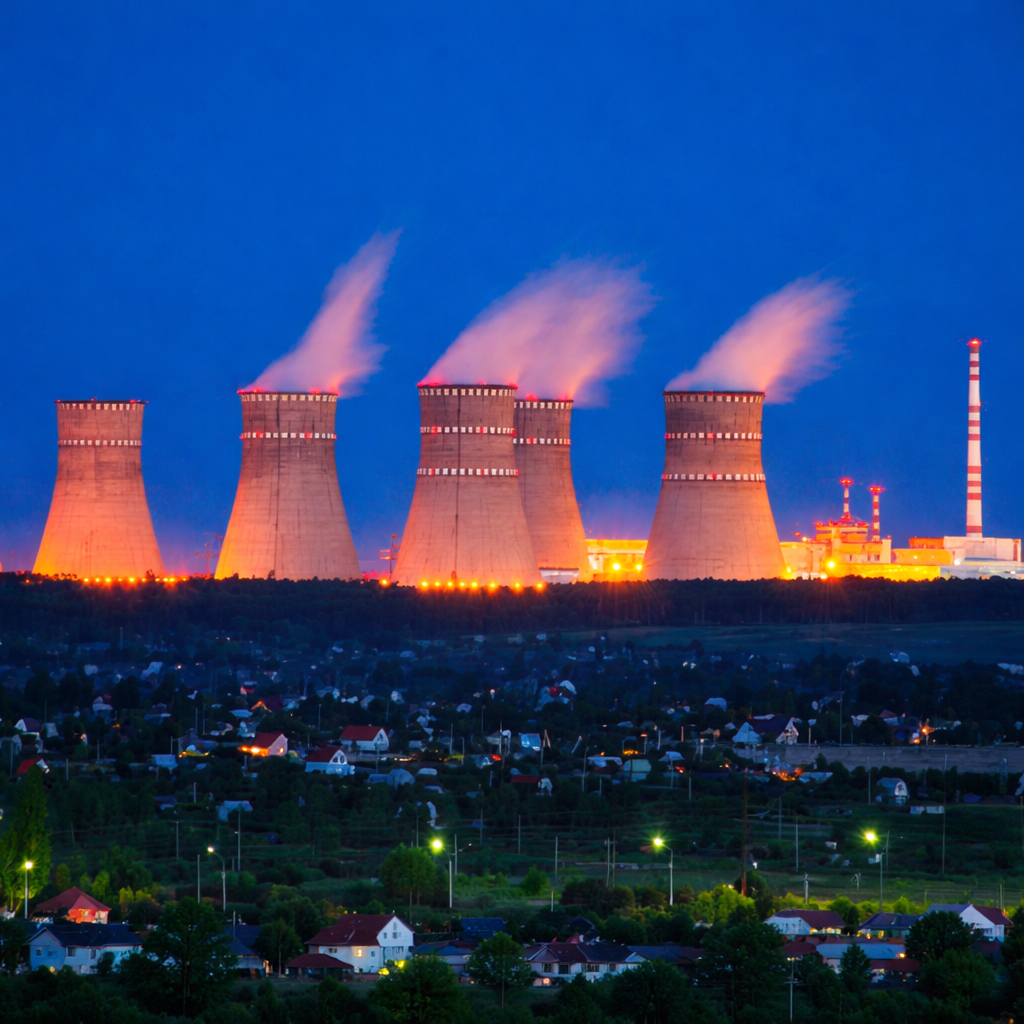
Hardly any global market is as strongly dominated by Russia as the export of nuclear power plants. The state-owned company Rosatom is not only active in China and India, but is also building Russian reactors in Turkey, a key NATO country. In early February, Rosatom celebrated the start of construction of another reactor in Hungary, a NATO and EU member state. However, the number of completed, ongoing, and agreed power plant projects abroad is limited. Rosatom's financial figures indicate that nuclear power exports have recently lost importance.
Russia is the undisputed world champion in the export of nuclear power plants (NPPs). In mid-2025, it was responsible for 19 of 22 reactor projects abroad, according to the WNISR industry report. In February 2026, another Russian export project was added in Hungary. The Russian state-owned company Rosatom, which conducts its foreign business through several subsidiaries such as Atomenergoexport and Rosatom Energy Projects, is also a leader in other areas of civil nuclear power. This includes the production and export of uranium, the fuel for nuclear power plants. We published this focus analysis on this topic in August 2024.

Apart from Rosatom, only companies from France and China are currently building nuclear power plants abroad. The French state-owned electricity supplier EDF, together with its reactor construction subsidiary Framatome, is responsible for the construction of the Hinkley Point C nuclear power plant in southwest England. Construction officially began in 2018 and 2019, respectively, with completion not currently expected before 2030. China is building by far the most new reactors. However, of the 33 projects currently underway, only one is abroad. At the end of 2024, construction began on Chashma-5 in Pakistan, the only export country for Chinese reactors to date. The state-owned reactor manufacturer China National Nuclear Corporation (CNNC) has already completed six reactors in the neighboring country since 2000. In the future, however, other host countries are likely to be added for Chinese nuclear power plants. As part of the Silk Road Initiative, Beijing wants to push ahead with the construction of around 30 reactors in Asia, the Middle East, and Africa, according to the trade magazine Nuclear Engineering.
Since the collapse of the Soviet Union, Russia has completed a total of nine commercial nuclear reactors abroad, according to an overview by the international industry association World Nuclear Association (WNA). These include the Tianwan 1 to 4 units in China, Kudankulam 1 and 2 in India, and Ostrovets 1 and 2 in Belarus. Probably the best-known project is the Bushehr nuclear power plant in Iran, whose only reactor to date began commercial operation in 2013. Its construction was originally decided in pre-revolutionary Iran in the 1970s and was an export project by Siemens. In the mid-1990s, Iran and Russia agreed to resume construction. Upon its completion almost two decades later, the Iranian Atomic Energy Organization (AEO) emphasized that it had succeeded in "integrating" Russian technologies with the approximately 12,000 tons of existing German equipment.

Currently, 20 reactors built by Rosatom abroad have reached official construction status. Four each are located in India, Turkey, China, and Egypt. Two reactors have been under construction in Bangladesh since 2017/2018, and one each in Iran and, most recently, Hungary.
The expansion of Iran's first and so far only nuclear power plant, Bushehr, began in 2016, and three years later, the first concrete was poured for the foundation of the reactor building. According to international criteria, this step marks the start of construction. This was the case for the first reactor at the Hungarian Paks II nuclear power plant on February 5, 2026. Rosatom is building two more reactors in Bushehr and another reactor in Paks. These projects are not yet included in WNA's list of ongoing Russian reactor construction projects, as they have not yet reached "first concrete" status.

The fact that Rosatom is allowed to build nuclear power plants in Hungary, a NATO and EU member state, despite Western sanctions is due to exemptions granted by the EU and the US. Rosatom itself has so far been exempt from harsh sanctions, not least because some European countries are dependent on Russian uranium supplies for their Soviet-era nuclear power plants.
Any sanctions will not stop Rosatom's existing projects abroad, London-based risk and strategy consultancy Knightsbridge said in fall 2024. At most, problems with payments and financing in general could slow down the implementation of new projects. The analysis also states that the loss of Western equipment such as Siemens gas turbines is not critical, as there are Chinese and now also Russian alternatives. Whether this forecast proves accurate will become clear during the construction of Paks II, for which Siemens equipment was also planned. Rosatom terminated the supply contract at the end of 2025 because the German government apparently did not grant an export license.
The construction of Bangladesh's first nuclear power plant, Rooppur, was agreed in 2011 with an intergovernmental agreement and reached the official construction stage for the first reactor in 2017 and for the second reactor a year later. Russia pre-financed the project with a loan of $11.4 billion, as reported by the Russian state news agency TASS in its overview. Almost simultaneously with Rooppur, Moscow also agreed with Belarus to build its first nuclear power plant and granted a loan of $10 billion for this purpose. The two units of the Ostrovets nuclear power plant went online in 2021 and 2023.
The construction of Egypt's first nuclear power plant, El Dabaa, was agreed in 2015 and began five years later. The mega-project on the Mediterranean coast, with an estimated cost of $30 billion for four reactors, is being made possible by a Russian loan of $25 billion. The first reactor is scheduled to go online in 2028.
In China, Rosatom is currently the only foreign nuclear power plant builder involved in two projects. At the Tianwan nuclear power plant, the Russians were responsible for the construction of four of the six existing reactors. They are currently building reactors 7 and 8, which will make Tianwan the world's largest nuclear power plant from 2028. Rosatom also plans to complete its work on units 3 and 4 of the Xudabao nuclear power plant by then. Rosatom is only contributing a relatively small part of the work on these four Chinese reactor projects. China's nuclear authority CAEA estimates the volume of the contract with the Russians at $3.1 billion, which corresponds to one-fifth of the total project costs.
In India, Rosatom is implementing the second and third construction phases of the Kudankulam nuclear power plant at the southern tip of the country, having already completed the first phase with two reactors around ten years ago. When the contract for the construction of reactors 3 and 4 was signed in 2014, the cost of the project was estimated at $6.4 billion, of which $3.4 billion was accounted for by the contract with Rosatom. Reactors 5 and 6, agreed three years later, were to cost a total of around $8 billion, with a contract value with Rosatom of $4.2 billion. In both cases, Russia is contributing Rosatom's share in full in the form of state loans.
In the case of Turkey's first nuclear power plant, Akkuyu, Rosatom is not only the builder, but also the owner and future operator. This is the first time worldwide that the so-called build-own-operate model has been used. CEO Alexei Likhachev estimated the construction costs borne solely by Rosatom at $24-25 billion in mid-2024. The company will later generate revenue from the project through a long-term electricity supply contract with guaranteed purchase prices. This year, the Turks are expected to award the contract for a second nuclear power plant, which is to be built on the Black Sea coast. According to Turkish media reports at the end of 2025, Rosatom is no longer the favorite, but rather companies from the US.
Rosatom generates around half of its foreign revenues from the construction of nuclear power plants. According to the group's annual report for 2024, published in fall 2025, this sector accounted for $8.75 billion of a total of almost $18 billion. This represented an increase of 79% compared to 2021. Another item listed is the fuel cycle, i.e., the extraction and enrichment of uranium, its conversion into nuclear fuel, and the return, reprocessing, or disposal of spent fuel elements. Rosatom earned almost $5.5 billion from this in 2024, 64% more than in 2021. Rosatom has not yet provided detailed information for 2025. In a TV interview, CEO Alexei Likhachev merely estimated total foreign revenues at $16.5 billion, which remained around 8% below the 2024 level.

According to Likhachev, the value of the total order portfolio amounted to $200 billion at the end of last year. The annual reports distinguish between the volume of orders over the entire lifetime of projects and, in particular, nuclear power plants, which can be in operation for several decades. At the end of 2024, this lifetime portfolio had a volume of $200.4 billion and remained at roughly the same level in previous years. In addition, the reports cite the respective volume of orders for the next ten years, which is likely to include new nuclear power plant projects. Here, Rosatom has recorded a significant decline since 2021, from $139.9 billion to $128.8 billion in 2024.
According to its own figures, Rosatom has an order portfolio of 33 large and 6 small reactors abroad as of the end of 2024. The company does not provide details on the construction projects and orders. This total includes reactors currently under construction whose contracts date from before 2022.

In the past, Russia has pioneered deeper cooperation in civil nuclear power with a number of other countries, including the construction of new nuclear power plants. Since 2018, Russian media have repeatedly reported that Russia and India have agreed to build six more reactors in the country, in addition to the two already completed and the four currently under construction. At the end of 2025, however, the Interfax news agency cautiously stated that India might be interested in another Russian nuclear power plant and small reactors. In 2009 and again in 2017, Russia agreed with Nigeria on cooperation in the field of nuclear energy, which also included the construction of the African country's first nuclear power plant. However, these intergovernmental agreements have not yet resulted in concrete plans or preparations for construction, nor have the memoranda of understanding that Rosatom signed last year with Ethiopia, Mali, and Niger, for example.
Rosatom has also secured new foreign projects beyond 2022. In mid-2024, Russia and Uzbekistan signed a contract to build the Central Asian country's first nuclear power plant. The plan was not to use the large Russian reactor types, which have an output of 1000–1200 megawatts, but six small reactors with an output of only 55 megawatts each. A year later, both sides amended the contract, which now provides for the construction of two large and two small reactors, as well as an option for two additional 1000-megawatt units. The official start of construction ("first concrete") was planned for March 2026, but according to the Uzbek government, it has been postponed by nine months from early 2026.
In Kazakhstan, Rosatom won the tender for the country's first nuclear power plant last year. The cost of the plant, which is planned to have two large reactors, is currently estimated at $15 billion. The contract and financing documents are in the final stages of approval, according to a mid-February 2026 announcement by Alexei Borodavkin, Russian ambassador to Kazakhstan. The original agreement between the two countries provides for financing through reduced-rate Russian loans. The Kazakh Atomic Energy Agency (AAE) expects work on the reactor foundation to begin in 2029. Russia had already
agreed with Iran in 2014 to build a total of eight large reactors, four in Bushehr and four in another future nuclear power plant. In the fall of 2025, Rosatom and Iran agreed on the construction of this second nuclear power plant with four units in the province of Hormozgan on the Persian Gulf. The Iranian news agency IRNA estimated the cost at $25 billion. Russian experts believe that financing is likely to be the key issue in the project. In view of Russia's high budget deficit, they consider a solution involving Russian export credits to be unlikely.
This article first appeared in the exclusive newsletter of the German-Russian Chamber of Foreign Trade.
Original article (German):
Read on ostwirtschaft.de →