Russia's airports after 2022
Russia's airports in 2026
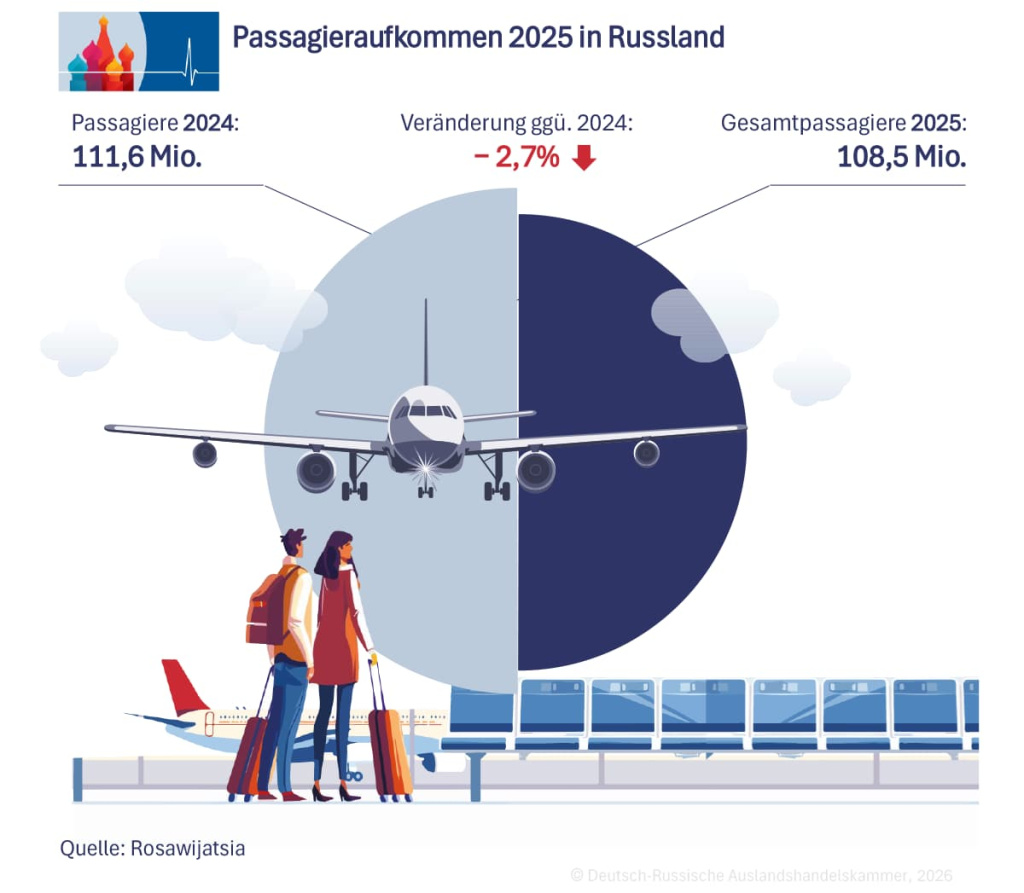
According to data from the aviation authority Rosaviatsiya, a total of 108.5 million passengers were transported in 2025. This represents a decline of 2.7% compared to 2024, when 111.6 million passengers were transported. After the crisis year of 2022, the market grew in 2023 and 2024, but is now shrinking.
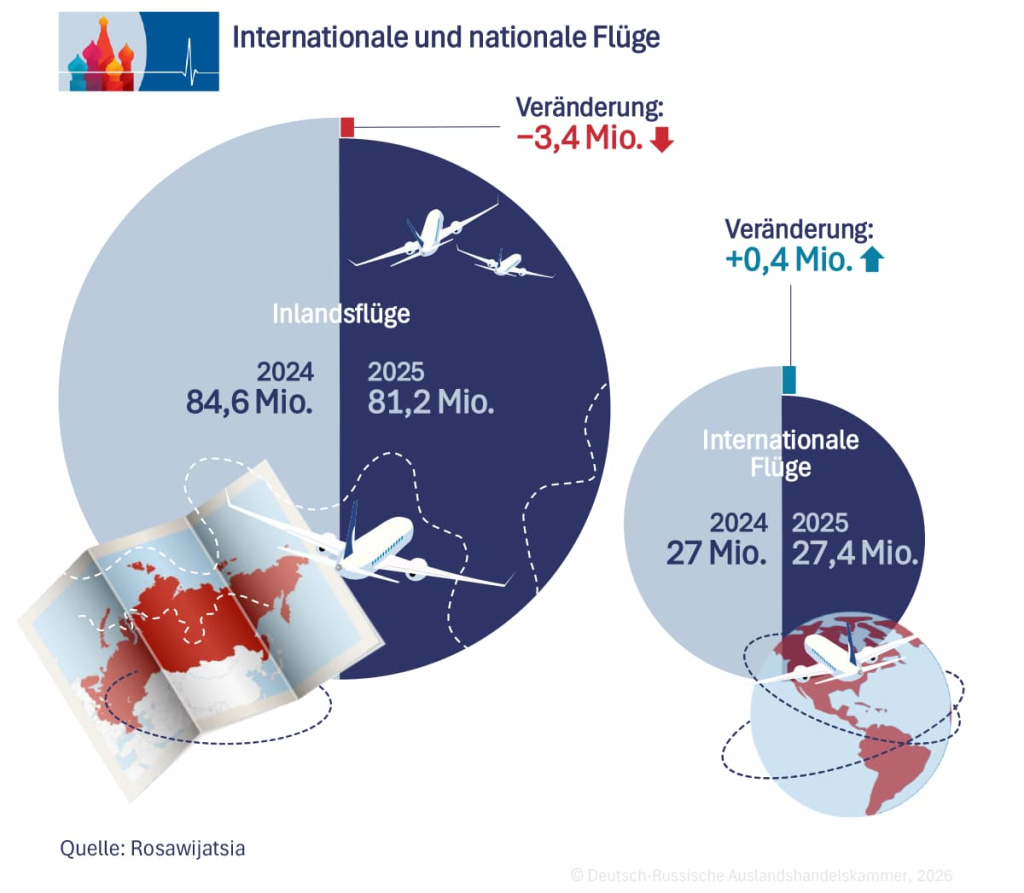
At the same time, traffic flows are shifting. Domestic traffic fell to 81.2 million passengers in 2025, down from 84.6 million in 2024. The decline of 3.4 million passengers marks a slowdown after three years of growth, which was mainly driven by government subsidies and the shift from foreign travel to domestic destinations. International traffic also developed slightly positively last year: 27.4 million international passengers were registered in 2025, up from 27 million in the previous year.
This development reflects the changed geographical structure of Russian air traffic. While traditional European connections have largely disappeared since 2022 due to the military conflict in Ukraine and Western sanctions, international flights to Turkey, the Middle East, Central Asia, and selected Asian destinations have stabilized. At the same time, the importance of domestic traffic remained high, accounting for more than 70%.
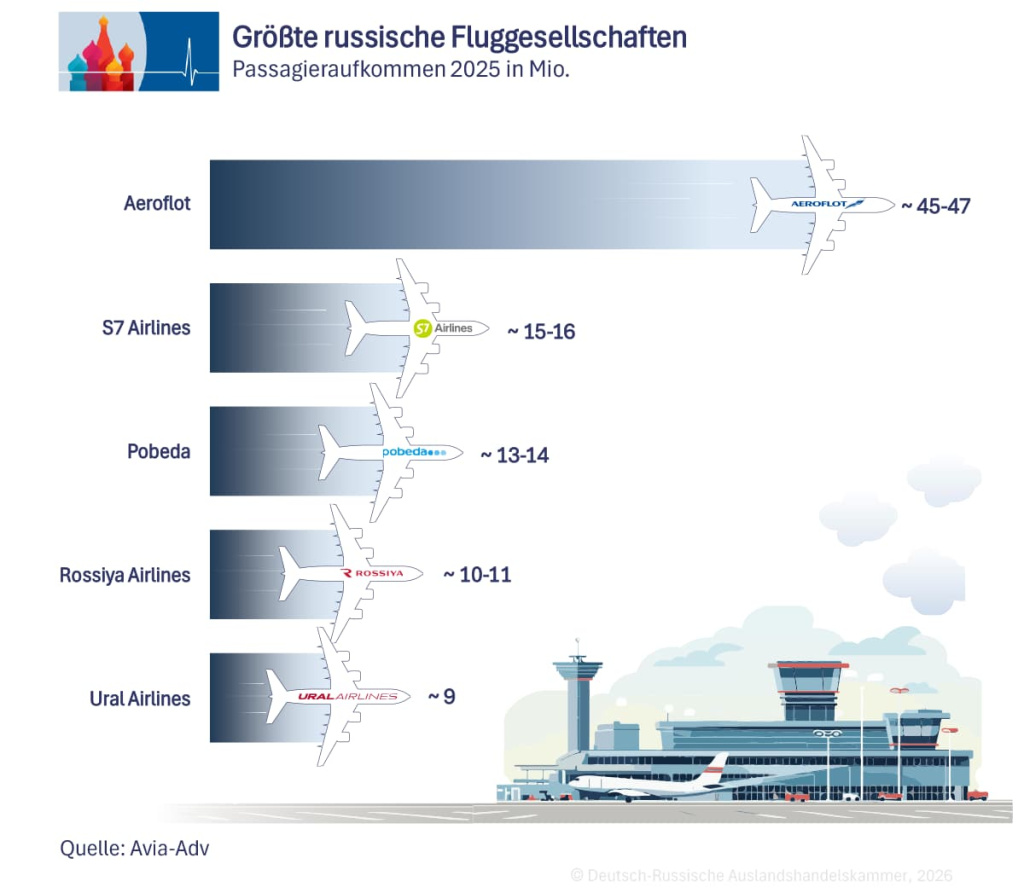
By 2025, Aeroflot – excluding its subsidiaries – is projected to be by far the largest airline in the country, with passenger traffic of around 46 million. Far behind is the private S7 Airlines with 15 to 16 million passengers. In third place is the Aeroflot Group's low-cost subsidiary, Pobeda, which carries 13 to 14 million passengers. Rossiya Airlines, also part of the state-owned Aeroflot Group, carried 10 to 11 million passengers. Ural Airlines is another major player in the Russian market, carrying around 9 million passengers.
Consolidation instead of competition: Sheremetyevo buys Domodedovo
"For years, Domodedovo Airport was a Russian success story," comments the New York Times on the sale of Moscow's Domodedovo Airport. "After its privatization in the 1990s, it developed into Moscow's second-largest airport. British Airways, Lufthansa, and other international airlines chose Domodedovo as their hub over state-owned competitors, making it the Russian capital's most important gateway to the world." At the end of January 2026, the operator of the competing Moscow Sheremetyevo Airport acquired the airport in an auction for around 66 billion rubles, equivalent to 730 million euros. The buyer is Sheremetyevo subsidiary OOO "Perspektiva," which is owned by the operating company of Sheremetyevo.
Domodedovo had already been nationalized in mid-2025 after the former owners, Dimitry Kamenshchik and Valery Kogan, were forced to cede their asset to the state by court order. This marked the end of a two-decade struggle over Domodedovo, during which the Russian state or state-affiliated groups had repeatedly attempted to take the airport away from its owners. In 2016, Dmitry Kamenshchik was placed under house arrest for several months on charges of inadequate security measures after a bomb attack in 2011 that left 37 people dead.
The public prosecutor's office accused Dmitry Kamentshik of holding foreign citizenship. Kamentshik rejects this and stated that he only had a nine-month residence permit for Turkey.
The subsequent sale process took place in two stages: an initial auction with only one bidder, who was disqualified due to allegedly incorrect documentation, failed in January 2026. The set starting price of 132 billion rubles, equivalent to around 1.5 billion euros, was portrayed in the Russian media as excessive. In fact, an expert opinion by a consortium of Western banks on the issuance of Eurobonds for Domodedovo more than five years ago had estimated the value of the airport at €5.4 billion. Unlike the sale process that has now been initiated, the expert opinion also included the airport's real estate.
The second auction was conducted as a so-called Dutch auction, in which the minimum bid was gradually lowered. The original starting price of 132 billion rubles, almost 1.5 billion euros, was ultimately halved.
The American daily newspaper New York Times writes: "To return to profitability and cover the costs of the new terminal, analysts say Domodedovo would need to bring passenger traffic back to pre-war levels. This would require a complete lifting of international sanctions and a resumption of relations with Europe – something that is not expected in the foreseeable future."
Last year, passenger traffic at Domodedovo fell by 11% compared to the previous year. Compared to 2019, the decline was as much as 35%. Since 2022, the airport had suffered greatly from the loss of European connections, which had previously accounted for a significant portion of transfer traffic. In addition, internal problems at the main local airline, S7 Airlines, weighed on the location.
The acquisition by Sheremetyevo also changed the ranking of airport operators in Russia. The owner group behind Sheremetyevo now controls the country's largest airport holding company in terms of passenger traffic.
The change of ownership at Domodedovo is part of a broader trend toward consolidation in Russian air transport. Competition between individual airports is increasingly giving way to large operating structures that dominate both the capital region and the regions.
At Domodedovo, the change of ownership was accompanied by far-reaching internal restructuring. According to information from the Russian business newspaper Kommersant, the airport management began cutting staff as early as the summer of 2025.
According to Kommersant estimates, between summer 2025 and early 2026, 200 to 300 employees left the company. At the end of January 2026, management announced further layoffs, particularly in the airline and partner operations areas. A total of around 7,000 people work at Domodedovo Airport's terminal. According to insiders familiar with the situation at the airport, the 18 subsidiaries, such as Domodedovo Catering, were also affected by similar offers of "voluntary resignation." "When I didn't go along with it, I stopped getting paid," said one person affected.
At the same time, the number of international airlines flying to Domodedovo Airport is shrinking. According to Kommersant, the Bahraini airline Gulf Air plans to move its flights from Domodedovo to Sheremetyevo in the spring. With the departure of Bahrain's Gulf Air, seven foreign airlines remain at Domodedovo: Emirates and Air Arabia from the United Arab Emirates, the Israeli airline El Al, EgyptAir, Royal Jordanian, Jazeera Airlines from Kuwait, and Ethiopian Airlines. Before the pandemic, around 20 international airlines served the airport, including British Airways and Lufthansa, which ceased operations in 2022.
Capital city airports in comparison
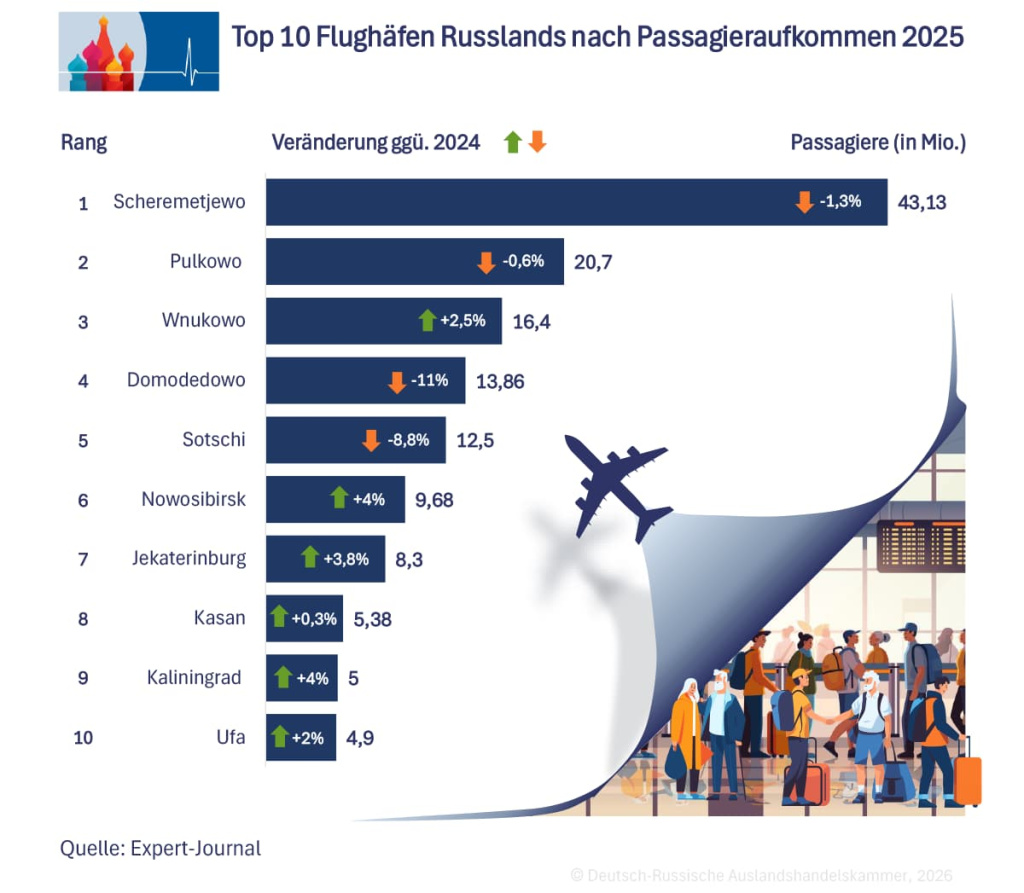
According to an analysis by the Russian monthly magazine "Expert," Sheremetyevo was once again Russia's largest airport in 2025 with 43.13 million passengers. However, this represented a slight decline of 1.3% compared to 2024.
In second place was Saint Petersburg Pulkovo Airport with 20.7 million passengers. Here, too, there was a slight decline (−0.6%). Pulkovo thus remained the most important airport outside Moscow.
Third in the ranking was Moscow Vnukovo Airport, which, with 16.4 million passengers, was the only major Moscow airport to grow, by +2.5%. Domodedovo followed in fourth place with 13.86 million passengers and the sharpest decline among the top 10 (−11.0%).
Regional hubs: Novosibirsk, Sochi, Kazan
In 2025, the largest regional airports recorded significant growth in some cases, while individual tourist destinations declined compared to 2024. In the ranking of the ten airports with the highest passenger numbers, Novosibirsk-Tolmatchevo Airport ranks sixth with 9.68 million passengers, recording a 4% increase over the previous year. In 2023, the airport got a new terminal, paid for by the state-owned Sberbank. Novosibirsk is considered the central transfer point for Western Siberia and the most important hub, as it is home to the headquarters of Russia's largest private airline, S7.
Yekaterinburg-Koltsovo Airport also performed well, handling more than 8.3 million passengers in 2025, 4% more than in the previous year. Domestic flights accounted for 5.8 million passengers, roughly the same as the previous year, while 2.6 million travelers used international flights, an increase of 16%. Yekaterinburg-Koltsovo is thus benefiting from its function as a hub in the Ural region and from the increasing importance of international destinations, which have shifted more strongly toward non-European target markets since 2022.
Kazan Airport remained stable. Passenger volume of around 5.38 million is forecast for 2025, which is almost on a par with the previous year's level. As the capital of Tatarstan, Kazan wants to further expand its role as a central air traffic hub in the Volga region in terms of infrastructure: according to the Russian Ministry of Transport, a fourth passenger terminal is scheduled to go into operation in 2026.
In contrast, Sochi Airport recorded a decline in 2025. Passenger volume was 12.5 million, a drop of 8.8%. International demand reached a record 1.8 million passengers, while total volume nevertheless declined. Russian industry analyses attribute the decline primarily to a redistribution in the southern corridor: in 2025, airports that had not handled any flights since 2022 partially resumed operations, including Krasnodar in September and Gelendzhik in July. This created alternatives for tourist and private travel, which in previous years had inevitably passed through Sochi.
Nine new buildings in over 30 years
Despite investments in new terminal buildings, the complete construction of new airports in Russia remained the exception. Domodedovo's Terminal 2, which opened in 2023, was the largest new terminal construction since the collapse of the Soviet Union. An overview by the state news agency TASS concludes that since 1991, nine airports have been built "from scratch" nationwide, three of them in the past five years. New buildings are capital-intensive and require lengthy planning and approval processes. Accordingly, in many cases, new airports serve to replace outdated infrastructure rather than to build additional capacity in regions that are already well served.
A prominent example is Saratov-Gagarin Airport, which opened in 2019. The new airport is located near the village of Saburovka, about 20 kilometers north of Saratov, and replaced the inner-city Saratov-Zentralny Airport, which was not designed to handle larger modern aircraft.
A second, equally characteristic project is the new airport in the Siberian city of Tobolsk. The new airport, named after historian and cartographer Semyon Remesov, opened there on September 24, 2021. Here, too, the focus was on restoring or fundamentally renovating infrastructure: the former airport had been closed in the 1990s. Other new airports have been built on the Kamchatka Peninsula and in Novy Urengoy in northern Siberia.
The airport near Rostov-on-Don, which went into operation in 2017, is described in a TASS background report as the first major international air traffic hub to be created "from scratch" in Russia since 1991. An analysis by the business newspaper RBC emphasizes its character as a new construction project "with complete aerodrome infrastructure," including a 3.6-kilometer runway.
2018 World Cup modernization project
Russian airport infrastructure received a significant modernization boost in the run-up to the 2018 FIFA World Cup. New terminals were built or existing ones were extensively expanded in several host cities. Key World Cup projects included new terminals in Kaliningrad, Volgograd, and Saransk. In Kaliningrad, the new passenger complex at Khrabrovo Airport went into operation in spring 2018 after many years of reconstruction; the terminal complex covers around 40,000 square meters and was designed to handle around 3.5 million passengers per year when it opened. In Saransk, a new terminal with 7,000 square meters of floor space was built, designed to handle 300 passengers per hour.
The World Cup not only served as an occasion for selective new construction, but also as a catalyst for a broader wave of investment in handling infrastructure at large and medium-sized locations. In 2018, for example, the new Terminal B went into operation at Moscow Sheremetyevo Airport. It has a total area of 110,500 square meters and a capacity of up to 20 million passengers per year. During the same period, new terminal capacity was also created at smaller locations.
The World Cup wave was followed by a second phase in 2019, when several larger new buildings went into operation, including in Khabarovsk and the Ural metropolis of Chelyabinsk. A reconstructed arrivals building was opened in 2019 for the Caucasus tourism hub of Mineralnye Vody.
Modernization did not come to a complete standstill even during the COVID-19 pandemic. In 2020, new terminals were opened in Petrozavodsk and Cherepovets. In the Karelia region bordering Finland, with its capital Petrozavodsk, a new terminal building opened its doors in 2020. New or significantly expanded passenger terminals in Kemerovo and Ufa followed in 2021.
Outlook for 2035: Big plans, open financing
The Russian government has announced a large-scale program to renew the air transport infrastructure over the coming decade. The key point is the modernization and expansion of 179 airports and airfields by 2035. According to the Russian Ministry of Transport, the number of airports is to be increased from 225 to 242. At the same time, the ministry points out that the infrastructure of 131 airports requires measures in the form of construction or reconstruction.
A key financing instrument is the state-initiated "Air Transport Infrastructure Development Fund" (Russian: Фонд развития инфраструктуры воздушного транспорта). According to government information, this fund will be used to finance the renovation of at least 50 airports by 2030.
The geographical focus of the programs is on regions with structural accessibility problems: Siberia, the Far East, and the Arctic. In the logic of state planning, air connections there are not only considered a transport service, but also basic infrastructure, because alternatives by road or rail are sometimes lacking or climatically limited.
The government is relying on a mix of budget funds, fund mechanisms, and private forms of participation to finance the projects. Private-public partnerships (PPPs) and concession models are regularly mentioned in the debate as a means of realizing projects outside the major cities. Investors are ready to participate in concession models for 26 regional airports, while financing structures for other projects still need to be developed, explained Dmitry Zhadrov, head of the Russian aviation authority Rosaviatsiya, in a conversation with Prime Minister Mikhail Mishustin.
This article first appeared in the exclusive newsletter of the German-Russian Chamber of Commerce.
This article first appeared in the exclusive newsletter of the German-Russian Chamber of Commerce.