Kazakhstan's service sector loses momentum

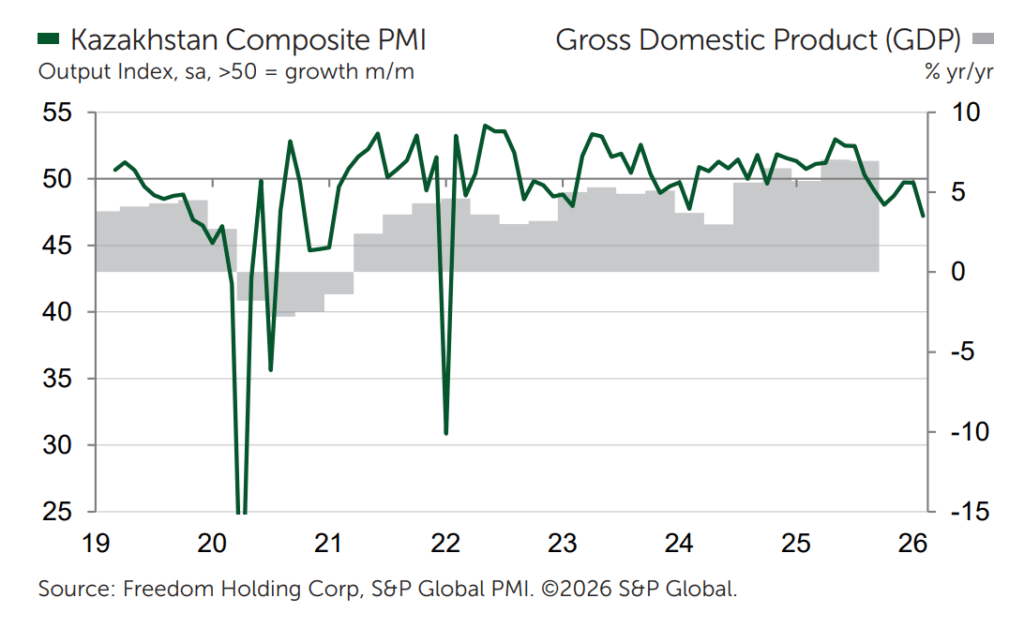
The service sector in Kazakhstan lost considerable momentum in February. New orders slumped particularly sharply—the most severe decline in almost four years. This is shown by the latest Purchasing Managers' Index (PMI) from Freedom Holding and S&P Global.
The index for business activity fell to 48.0 points in February, down from 50.5 points in January. This took it below the growth threshold of 50 points. The figure signals a slight decline in business activity and marks the sharpest deterioration since February 2023. Activity has contracted in four of the last five months surveyed.
New orders also declined significantly. Many companies reported weaker demand. At the same time, costs continued to rise.
Companies cite the VAT increase introduced at the beginning of the year as a major burden. Despite a slight decline in inflation, it continues to drive up both input costs and selling prices.
Many service providers responded to weaker demand by cutting jobs, reversing the slight increase in employment seen in January.
Despite the weaker business performance, sentiment in the industry has improved slightly. After hitting rock bottom in December, companies are now somewhat more optimistic about the coming months, even though the general business climate remains subdued.
Yerlan Abdikarimov, head of financial analysis at Freedom Finance Global, said the service sector experienced its sharpest decline in demand in four years in February.
In January, many companies tried to absorb the tax shock by lowering their margins. However, the current decline in employment and activity shows that this internal buffer has largely been used up.
Although overall inflation has eased slightly recently, cost pressures remain high. The difference between input costs and selling prices more than tripled in 2026 compared to the average of the past two years. This highlights the growing pressure on margins amid weak demand.
At the same time, many companies expect a slight stabilization in the coming twelve months. The industry is therefore showing cautious optimism as it adapts to the new fiscal environment.
Original article (German):
Read on ostwirtschaft.de →