Russia
Russian entrepreneurs: key interest rates must be lowered more sharply
Author: Klaus Dormann
On April 24, the Russian central bank once again lowered its key interest rate by only half a percentage point to 14.5% per annum. The Russian Union of Industrialists and Entrepreneurs had previously called for a reduction of twice as much by one percentage point to strengthen growth.
In the first two months of 2026, overall economic production was 1.8% lower than a year ago, according to estimates by the Ministry of Economy. However, in its medium-term economic forecast updated on the occasion of the key interest rate decision, the central bank maintains that the Russian economy is likely to grow by 0.5 to 1.5 percent year-on-year in 2026 as a whole. Almost all forecasts by international economic organizations, research institutes and banks are currently within this range.
As reported by Handelsblatt, the Vienna Institute for International Economic Studies (wiiw) also continues to expect economic growth of around one percent in Russia in its spring forecast, which will be officially presented at the end of April. Previously, the institute assumed that Russia's economic growth would accelerate from 1.0 to 1.2 percent this year. It has now lowered its growth forecast for 2026 slightly to 0.9%, according to Handelsblatt. According to the article, wiiw Russia expert Vasily Astrov expects higher revenues from oil sales to be a "major one-off effect" for the Russian state budget. However, the government will primarily use the additional revenue to reduce the budget deficit, not for "economic stimulus programs" (FR.de).
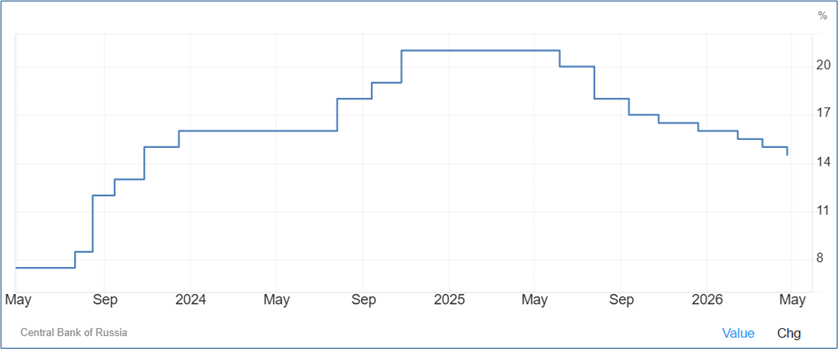
The key interest rate has been cut by a total of 6.5 percentage points since June 2025
In October 2024, the central bank raised the key interest rate to a long-term record of 21% to curb inflation. It only began to cut the high key interest rate at the beginning of June 2025. The "easing" of its monetary policy, which has often been criticized as too "restrictive", was most recently continued in February and March with cuts to the key interest rate of 0.5 percentage points each in two further small steps (Interfax.com).
Key interest rate of the Russian central bank in percent per year
Trading Economics: Russia Interest Rate
The central bank raised its key interest rate forecast slightly due to higher inflation risks
The base scenario of the central bank's forecast assumes that the key interest rate will average 14.0% to 14.5% in 2026, around 5 percentage points lower than in 2025. In 2027, the key interest rate is to be lowered further to between 8.0% and 10.0% per year with an inflation rate of 4% (see third line of the table below).
In her statement on the key interest rate decision, Central Bank President Nabiullina pointed out that the central bank had raised its key interest rate forecast slightly. The background to this is that the inflation risks in Russia have increased significantly due to the conflict in the Middle East and also with regard to the development of the national budget.
The annual inflation rate is expected to fall from 8.7% to between 5.1 and 5.6% in 2026
According to the central bank's forecast, the annual increase in consumer prices will fall to between 4.5% and 5.5% in December 2026 (see first line of the table).
The central bank expects an average inflation rate of 5.1 % to 5.6 % in 2026. In 2025, it was still 8.7%. According to the forecast, the price increase will meet the central bank's inflation target of 4.0% from 2027.
Central Bank of Russia:Forecasts for inflation, key interest rate and growthGrowth compared to previous year in %, unless otherwise stated
Bank of Russia: Bank of Russia's medium-term forecast, 24.04.26; excerpt
The central bank continues to expect economic growth of 0.5 to 1.5% in 2026
The central bank's press release on the key interest rate decision points out that Russia's economic growth slowed in the first quarter of 2026 "according to high-frequency data". However, the central bank does not provide its own estimate for the growth rate in the first quarter.
Among the reasons for the slower growth in the first quarter, the central bank points to the economy's reaction to tax changes (which probably refers to business activities being brought forward to 2025 due to the VAT increase at the beginning of 2026). Other slowing factors in the first quarter were the lower number of working days and unfavorable weather conditions. As the slower growth in the first quarter of 2026 was therefore significantly influenced by "one-off factors", the central bank is sticking to its previous forecast for growth in 2026 as a whole of 0.5% to 1.5%.
"Exact" growth in 2026 can only be said after two quarters
In her statement, Central Bank President Nabiullina pointed out that the first two months of 2026 had three fewer working days than January and February 2025. According to Central Bank estimates, this has led to a decline in annual GDP growth of up to 0.5 percentage points in the first quarter of 2026. In the second quarter, however, the months of May and June would have three more working days than in the previous year. Nabiullina draws the following conclusion:
"All this means that we will only be able to assess the development of production more accurately when we look at the statistics for the first six months of 2026 as a whole."
At the moment, the central bank governor is commenting on Russia's growth prospects:
"According to our estimates, the moderate economic performance in the first quarter of 2026 will be offset in the following periods. In addition to calendar effects, this will be due to a partial recovery in consumer and investment activity, which is already evident in the high-frequency data for March and April.
Higher prices on the global commodity markets should provide additional support for domestic demand. Against this backdrop, we confirm our GDP growth forecast for this year unchanged at 0.5% to 1.5%."
At the press conference, Nabiullina reiterated that she saw no danger of the economy "overcooling". She emphasized that the central bank would only cut interest rates faster if inflation, currently at 5.9 %, fell below the target level of 4 % and unemployment began to rise. Nabiullina's first deputy, Alexei Zabotkin, stated that the GDP data for the first quarter, which will be published in May, would differ "for the better" from the data in January and February (Reuters).
What indications there are of a revival in growth
Nabiullina points to signs that Russian companies are increasing their investment plans and that consumer demand could pick up. In view of the increased prices for energy and raw materials on the global markets, companies active in the mining sector could now revise their investment plans upwards. Construction companies are now trying to make up for the weather-related production losses from the winter.
According to Nabiullina, there were also signs of a recovery in consumer demand in March, particularly in car sales. Overall, however, growth in consumption will be more moderate in 2026 than in 2025. In its medium-term forecast, the central bank assumes that growth in private household consumption will slow from 3.6% in 2025 to just 0.5 to 1.5% in 2026. In terms of gross investment, it expects growth of 1.0 % to 3.0 %, following a decline of 4.9 % last year (see table above).
The situation on the labor market is gradually easing
In its press release, the central bank points out that unemployment remains at a historic low and that wages are continuing to rise faster than labor productivity. At the same time, however, it notes that, according to surveys, the proportion of companies reporting a shortage of labor is continuing to fall. It is now at its lowest level since mid-2023 and companies are now planning more moderate wage adjustments for 2026 than in the 2023-2025 period.
The oil price forecast has been raised by USD 20 to USD 65 per barrel
Nabiullina commented on Russia's foreign trade development in view of the war in the Middle East:
"The situation in the Middle East remains uncertain. According to our baseline scenario, the conflict will lead to a slowdown in global economic growth, a global increase in logistics and energy costs, higher global inflation and higher interest rates."
In its forecasts for Russia's external economic development, the central bank made the following changes compared to the forecast of February 13, among others:
The forecast for the Russian oil price (for tax purposes) in 2026 was increased from the previous USD 45 to USD 65 per barrel (see last line of the following table).
Russia's revenues from the export of goods will increase by around 15% from USD 422 bn to USD 485 bn in 2026. In February, exports were still expected to fall to USD 399 billion.
At USD 155 billion, the surplus in the foreign trade balance for 2026 is now estimated to be around 70% higher than previously (USD 90 billion).
However, the central bank believes that the impact of these additional export earnings on the rouble exchange rate will be largely offset by government intervention in the foreign exchange market, the application of the so-called "fiscal rules".
Central Bank of Russia:Development of balance of payments and oil price until 2028Billion US dollars, unless otherwise stated
Bank of Russia: Bank of Russia's medium-term forecast, 24.04.26; excerpt
Risks for the central bank forecasts
However, Central Bank President Nabiullina also sees risks for Russia from the war in the Middle East. She emphasized:
"If the conflict drags on, the negative impact on the Russian economy will intensify. The consequences of rising global costs could prove to be more serious than the benefits of higher exports and a stronger rouble."
At the same time, Nabiullina also drew attention to inflation risks that could emanate from the development of the Russian state budget. In the first quarter of 2026, government spending had significantly exceeded the already high levels of the previous year. The President emphasized that the stronger the "fiscal stimulus" for demand, the more the central bank would have to curb lending. This means that the higher the budget deficit, the higher the key interest rate must be kept.
Business association RSPP had called for a reduction of one percentage point
Alexander Shokhin, Chairman of the Russian Union of Industrialists and Entrepreneurs (RSPP), had called on the Central Bank's Board of Directors to cut the key interest rate by a whole percentage point before the decision on the key interest rate. If the key interest rate were to fall from 15 to 13 percent by the end of the year with a gradual reduction of only half a percentage point at a time, this would not be enough to stimulate investment. "It would be right to take more radical measures here and cut the interest rate by one percentage point instead of taking small steps of 0.5 percentage points," Interfax quotes Shokhin's criticism (Kommersant.ru).
Shokhin commented on the decision to cut the key interest rate to 14.5% on the radio station Business FM (RSPP press release):
"When I called for a 1% rate cut, I meant that we could reach 10% or maybe even single digits by the end of the year." Not only for large companies, but also for medium-sized and small companies, such rates are crucial for the development of willingness to invest.
"Many investment projects are currently on hold," explained the Chairman of the Russian Union of Industrialists and Entrepreneurs. "A recovery in investment activity is possible at a rate below 10%. The Central Bank traditionally calls for a focus on the development of inflation. This requires not only scientific knowledge - models, formulas, etc. - but also sensitivity. We need a feel for how to prevent production from falling below the level of a slowing economy on the one hand and how not to fuel the inflationary spiral on the other."
Vice-President Alexander Murychev said in an RSPP press release that the key interest rate cut was of course a positive signal. However, the extent of the reduction is not enough to satisfy the need of companies for significantly cheaper loans.
Fundamental criticism of the central bank's monetary policy and the government's economic policy from Russian business circles is documented in a two-part report by russland.capital (with video interviews) on the "Moscow Economic Forum", in which Sergei Glazyev, State Secretary of the Union State of Russia and Belarus, also took part.
Will Elvira Nabiullina be replaced as President of the Russian Central Bank?
In the run-up to the key interest rate decision, Mike Eckel investigated in an article for "Radio Free Europe Radio Liberty" the question of whether Elvira Nabiullina, who has headed the central bank for almost 13 years, has now also fallen out of favor with President Putin.
Dismissing Nabiullina now would cut the only "institutional anchor" that has retained the "credibility of the markets", Aleksandra Prokopenko, former advisor to the central bank and current employee of the Carnegie Russia Eurasia Center in Berlin, told him. For Prokopenko, Nabiullina's replacement would be a sign of the government's weakness. The law stipulates that her mandate as President of the Central Bank ends in one year. Prokopenko said it was unlikely that Putin would replace her before then. The "more interesting question" for Prokopenko is whether an independent personality at the head of the Central Bank will be less welcome to the Kremlin in a year's time than it is now, or more.
"If they sack Nabiullina, the whole economy will panic," said Nicholas Birman-Trickett (S&P Global Associate Director). In his view, "the Kremlin" does want lower interest rates. However, President Putin also knows that a "yes-man" at the head of the central bank would be fatal.
Richard Portes, professor at the London Business School, said to Eckel: "There is no one better qualified to head the Russian central bank than Nabiullina." "Putin can rant all he wants. That won't improve the situation of the Russian economy, which is pretty disastrous," said Portes. "I think he has every reason to be concerned."
What Eckel reports on growth and public finances
Mike Eckel summarized the economic development of the Russian economy in his article as follows: Last year, GDP growth slowed significantly, from 4.9 percent in 2024 to just 1 percent in 2025. In the first two months of 2026, the economy shrank by 1.8 percent year-on-year, according to government estimates. The government has signaled that its current growth forecast for 2026 of 1.3% may soon be revised downwards.
The turnaround in the economy was reflected in the federal budget: the deficit soared to 4.5 trillion roubles (60 billion US dollars) in the first three months of 2026. It is around twice as high as in the same period of the previous year because income from oil exports fell (Eckel refers to preliminary estimates from the Ministry of Finance from April 8).
Reschetnikow: The economy's reserves are "largely exhausted"
Eckel also quotes from a speech by Economics Minister Maxim Reshetnikov at an economic forum in Vladivostok with reference to a report in the daily newspaper Nezavisimaya Gazeta. According to an Interfax report, the Minister of Economy argued at the economic forum, among other things, as follows:
'The situation in the Russian economy is currently more difficult than in recent years due to the strong ruble, high interest rates, labor shortages and limited public spending opportunities. Until now, there were still reserves somewhere in the economy. However, these reserves have now largely been used up. The macroeconomic situation has become much more difficult.
The rouble exchange rate is currently and will probably continue to be stronger than we would like and have assumed in earlier forecasts.
Interest rates are also quite high. Of course, it is encouraging that they are falling, but given the current budget situation and other factors, interest rates are likely to fall somewhat more slowly than we would like.
The main task for companies in the near future is therefore to reduce costs, find ways to make the best use of available resources and ultimately increase labor productivity. The government's task is to support them in this.
Estimates of the VEB Institute on GDP development in the first two months
The VEB Institute has published estimates of how production in the Russian economy has developed up to and including February 2026, adjusted for seasonal and calendar effects. According to these estimates, Russian gross domestic product rose by 0.8% in February compared to the previous month following a deep slump in January.
Index of real gross domestic product; seasonally and calendar-adjusted; Jan. 2014=100
VEB Institute: Russia's economy in February/March 2026, 10.04.26
Construction, wholesale, goods transport, services and industrial production contributed to the increase in real GDP in February. By contrast, passenger transportation and gastronomy recorded a decline in production. Agriculture and retail hardly grew at all.
Reading tips:
Monetary policy:
Russian Union of Industrialists and Entrepreneurs: Alexander Shokhin assessed the possibility of the key rate reaching single digits, 24.04.26; Commentary by RSPP Vice President Alexander Murychev on the Central Bank’s key rate decision; 24.04.26
Finam.ru; Olga Belenkaya: The Russian Central Bank expects a key rate cut and a slightly upwardly revised forecast, 24.04.26; Finam.ru; Olga Belenkaya: The key rate was cut as expected, and the forecast was revised downwards, 24.04.26
The Moscow Times: Russia's Central Bank Cuts Key Rate to 14.5%, 24.04.26
Interfax.com: Russia's Central Bank cuts key rate by 50 basis points to 14.5% per year, 24.04.26; Interfax.com: Central Bank maintains forecast for Russia’s GDP growth in 2026 at 0.5%-1.5%, at 1.5%-2.5% for 2027, 24.04.26; Interfax.com: Investments in Russia will return to last year's level in 2026, March/April indicate recovery - Central Bank Governor says, 24.04.26; Interfax.com: Rise of inflationary risks requires a more cautious approach to monetary policy decisions - Governor of the Central Bank of Russia, 24.04.26
RTE 100; AFP: Russia cuts benchmark interest rate to 14.5% as economy slows, 24.04.26
Reuters; Published by Global Banking & Finance Review®: Russian Central Bank Cuts Key Rate by Only 50 Bps, Raises Oil Price Forecast on Iran War, 24.04.26
Bank of Russia: Statement by Bank of Russia Governor Elvira Nabiullina in follow-up to Board of Directors meeting on April 24, 2026, 24.04.26
Bank of Russia; Press Release: Bank of Russia cuts the key rate by 50 bp to 14.50% p.a., 24.04.26
Briefly News.com; Bloomberg: Russia's central bank likely to cut rates again as economy loses momentum, 24.04.26
Kommersant: The chairman of the Russian Union of Industrialists and Entrepreneurs (RSPP) called on the Central Bank of Russia to cut the key interest rate by one percentage point, 23.04.26
Reuters; published by Global Banking & Finance Review®: Russia’s Economic Contraction May Spur Key Rate Cuts, Analysts Say, 23.04.26
Kommersant: Reshetnikov: The task of lowering inflation in Russia is largely accomplished, 23.04.26
FOCUS-online editorial office: Billions in losses. Putin admits economic problems – Banks in Russia are sitting on loans, 22.04.26; Yahoo Finance; The Telegraph, Melissa Lawford: A banking crisis made in the Kremlin is gripping Russia, 22.04.26
Radio Free Europe, Radio Liberty; Mike Eckel: Entangled In Russia’s Faltering Economy: The Fate Of Its Respected Central Banker, 21.04.26
Ostwirtschaft.de: Russia's fight against inflation is becoming more difficult. High wages, robust demand and new foreign trade risks complicate Russia's fight against inflation, 21.04.26
Fiscal policy; state budget and oil prices:
Finam.ru: According to Siluanov, inflation processes in the Russian economy are stabilizing, 18.04.26
Re:Russia: Oleg Vyugin: Expertise: A Cancelled Manoeuvre: The Challenges Facing Economic and Fiscal Policy in 2026, 16.04.26
BondGuide; Alexander Kolyandr and Alexandra Prokopenko (THE BELL): Russia wastes no time with high oil prices: but spending still outstrips revenues, 17.04.26
Focus.de; Lars-Eric Nievelstein: Russia's budget deficit hits annual target after only three months. Russia's economy is under pressure. Revenues are weakening enormously. 17.04.26
Overall economic development:
FR.de; Marcus Giebel: Putin slips Russia's economy - many sectors in distress, 24.04.26
Ntv.de; André Ballin, dpa: Minus instead of growth. Russia's war economy shrinks unexpectedly, 24.04.26; MSN.com, dpa: Russland droht persistent Wirtschaftsflaute, 24.04.26
MSN.com; The New Voice of Ukraine: Rising oil prices won't save Russia's faltering economy from recession - Bloomberg, 22.04.26
Finam.ru; Alexey Primak, expert at the Institute of Financial and Investment Technologies: Investments are shrinking - and we pretend everything is normal? 22.04.26
The Moscow Times: Russian Companies Freeze Hiring as Demand Cools, Central Bank Says, 21.04.26
Finam.ru: Debriefing by Natalia Asedova: Labor shortage: What are the risks for the Russian economy? 21.04.26
Merkur.de; Nils Thomas Hinsberger: Putin's crisis: Russia's economy still in danger - despite rising oil prices, 20.04.26
ndtv.com; Prateek Shukla: Oil Revenue vs Ukraine War Bills: Is Russia Hiding Economic Stress? The non-oil deficit remains deeply negative. This means Russia still relies heavily on energy exports to balance books, 23.04.26
The Spectator; Alexander Kolyandr, Centre for European Policy Analysis: Is Russia's economy really on its last legs? The head of Swedish military intelligence,Thomas Nilsson, told the Financial Times this week that Russia's economy is far weaker than it appears, that the Kremlin systematically manipulates its statistics. One need not be a Kremlin agent to find this less than convincing. 21.04.26; inosmi.ru: The collapse of the Russian economy: fact or fiction? The Spectator: The West grossly exaggerates Russia's weakness; original article; 22.04.26; Euro News; Emma De Ruiter & Dimitri Kavalerov: Russia faked economic data to appear more resilient to its war and sanctions, intel report says, 21.04.26; Business Insider Germany: Russia's economy is heading for "a financial catastrophe", according to Swedish military intelligence, 20.04.26
Nezavisimaya Gazeta; Anastasia Bashkatova: The budget is not able to subsidize loans for everyone who wants them. Minister of Economic Development Maxim Reshetnikov stated that the economy’s reserves are depleted, 19.04.26; Interfax.com: The reserves of the Russian economy are largely depleted, the macroeconomic situation is more difficult than in recent years - Reshetnikov, 17.04.26
LIGA.net news editor Vira Kasiyan: Russia admits that the economy's reserves are "almost exhausted". The Minister of Economic Development of the Russian Federation stated that the macroeconomic situation is much more difficult than in previous years, 17.04.26
Jungle World; Katja Voronina: Putin is asking for money. Russia's economy is under pressure. The pruvate debt is rising, the economy is weakening, the budget deficit is growing, 16.04.26
War, energy supply, energy prices and Russia:
Dow Jones; Dr Dafne Ter-Sakarian, Senior Analyst, Russia & Eurasia: Moscow will use Iran war windfall to avoid budget cuts, 22.04.26
DW.com. Arthur Sullivan: Russia to block Kazakh oil flows to Germany via key pipeline, 22.04.26
tagesschau.de: Crude oil from Kazakhstan. Russia stops oil transit to Germany, 22.04.26
Berliner Zeitung, Flynn Jacobs: Druzhba pipeline. Russia stops Druzhba oil: Gasoline shortages now loom in eastern Germany. The petrol station association warns of rising fuel prices, 22.04.26
Inosmi.ru: LNG: Turkey opens market for Russia despite EU plans for 2027; BZ: Turkey considers expanding Russian LNG imports, 22.04.26; Original article: Berliner Zeitung+; Flynn Jacobs: LNG: Turkey opens market for Russia - despite EU exit from 2027; 21.04.26
Finam.ru; Ekaterina Krylova, PSB Center for Analytics and Expertise: The Strait of Hormuz: A global logistics shock in 2026, 21.04.26
Berliner Zeitung, Anika Schlünz: US extends easing of sanctions on Russian oil. The US Treasury Department is extending an exemption for the purchase of Russian oil. Treasury Secretary Scott Bessent had previously announced the opposite, 18.04.26
t-online.de; Analysis by Patrick Diekmann: War in Ukraine. Putin's Russia is bleeding to death, 17.04.26
Forecasts:
wiiw: Spring Economic Forecast Eastern Europe, 29.04.26
Interfax.com: Central Bank maintains forecast for Russia’s GDP growth in 2026 at 0.5%-1.5%, at 1.5%-2.5% for 2027, 24.04.26
Bank of Russia: Bank of Russia's medium-term forecast, 24.04.26
Bank of Russia: Macroeconomic survey of the Bank of Russia, 15.04.26
International Monetary Fund: World Economic Outlook; Global Economy in the Shadow of War, 14.04.26
Ostwirtschaft.de: IMF raises Russia forecast,16.04.26
Weekly and monthly economic reports:
Politkom.ru; Marina Voitenko; Weekly report: global economy in supply shock, 24.04.26; Budget deficit amid downward macrodynamics, 16.04.26; Macro trends point to likely quarterly contraction, 09.04.26
BOFIT, Bank of Finland; Weekly Review 17/2026: Fixed investment growth in Russia came to a standstill last year; 24.04.26; Weekly Review 15/2026: Russian GDP growth to remain at last year's level boosted by higher commodity prices this year, growth will decelerate in 2027 and 2028, 10.04.26
VEB Institute: World Economy and Markets, April 10 to April 16, 2026; 17.04.26
Economic data:
Kommersant; Artem Chugunov: Industry increased production in March, 23.04.26
Finmarket.ru: Industrial production in Russia increased by 2.3 % in March, 22.04.26
The post Russian entrepreneurs: key interest rates must be lowered more appeared first on ostwirtschaft.de.
Original article (German):
Read on ostwirtschaft.de →