Russia's growth is driven by consumer spending and defense spending
Author: Klaus Dormann
On October 28, the Federal State Statistics Service (Rosstat) released data on production trends in key economic sectors for September. According to preliminary estimates by the Ministry of Economic Development in its report “On the Current State of the Economy,” production across the entire Russian economy in September was likely 0.5% higher than a year ago. In the third quarter and in the first nine months of 2026, real gross domestic product rose by 0.6% compared with the same period last year.
The Russian government also forecasts a 0.6% increase in aggregate economic output for the full year 2026. This assessment is confirmed by the Moscow-based economic research institute “Center for Macroeconomic Analysis and Short-term Forecasting” (CMASF). In a forecast for 2026 published on October 30, the center now expects economic growth of between 0.5% and 0.7%.
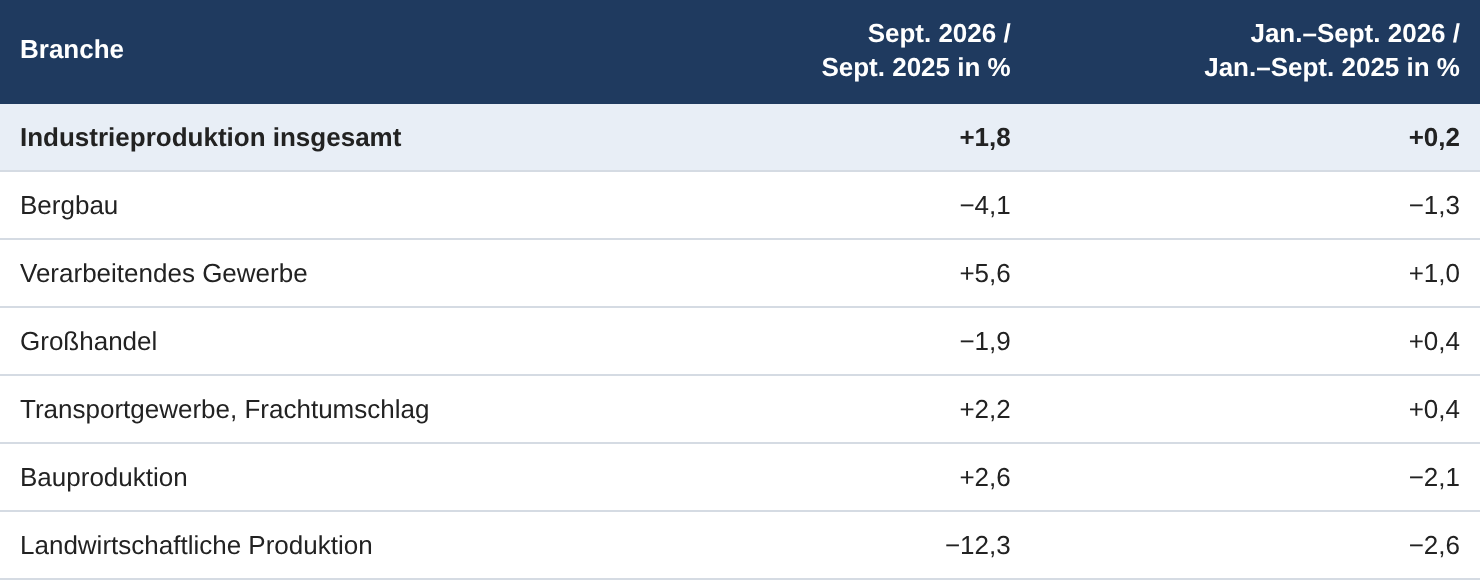
The 0.5% growth in September was driven primarily by defense contracts for industry and consumer spending. Industrial production rose by a total of 1.8% in September compared to September 2025. The annual increase in total sales in retail, services, and the restaurant industry, as calculated by the Ministry of Economic Affairs, accelerated to 3.6% in real terms in September (August: 2.9%).
How has production in key sectors developed through September?
From January through September, real retail sales in particular rose sharply compared with the previous year (+5%). Private consumer spending thus supported the modest growth of the overall economy.
Industrial production, on the other hand, remained virtually flat overall in the first nine months compared with the previous year, rising by only 0.2%. Production in the “Mining” sector fell by 1.3%. Production in the “manufacturing” sector was, however, still 1% higher from January through September than in the previous year, even though production of “coke and petroleum products” fell by 11% due to damage to production facilities caused by attacks from Ukraine.
According to TASS, growth in “manufacturing” production was driven primarily by production for military purposes. The highest annual growth rates for the period from January through September were recorded in the following “defense-related” sectors:
- Other transportation vehicles and equipment (including aircraft and shipbuilding): +19.9%
- Metal products (excluding machinery and equipment): +12.1%
- Pharmaceuticals, materials for medical purposes: +10.3%
- Computers, electronic, and optical products: +9.1%
Unexpectedly Strong Growth in the Manufacturing Sector in September
In September, production in the “manufacturing sector” performed significantly better than before. It rose by 5.6% year-over-year, following a 0.5% decline in August. The largest contributor to this was the machinery sector, where growth accelerated sharply from 6.2% to 21.3% (Kommersant). On the other hand, the decline in mining production deepened to 4.1% in September.
Overall, industrial production growth reached 1.8% in September. Analysts, however, had expected not an increase but a 0.1% decline (following a 0.6% decline in August, Finmarket.ru).
Production in key sectors in September and year-over-year change since January
, in percent
Sources: Rosstat, Ministry of Economic Development of the Russian Federation; Finmarket.ru, Oct. 28, 26
Real wholesale sales fell by 1.9% in September, following a 0.5% decline in August (up 0.4% for the January–September period).
Freight volume in the transportation sector rose by 2.2% year-over-year in September, following a 4.2% increase in August. However, in the first nine months, it was only 0.4% higher than in 2025.
Construction output rose by 2.6% in September, following a 2.7% increase in August. Since the beginning of the year, however, it has fallen by 2.1%.
Agricultural output fell by 12.3% year-over-year in September, following a 6.6% increase in August. This trend in agriculture is considered the main reason why annual growth in total economic output slowed from 0.8% in August to 0.5% in September (Finmarket.ru). From January through September, agricultural production was 2.6% lower than in 2025; in the third quarter, it fell by 3.9% compared with the same period last year.
This is how strongly industrial production has recovered so far
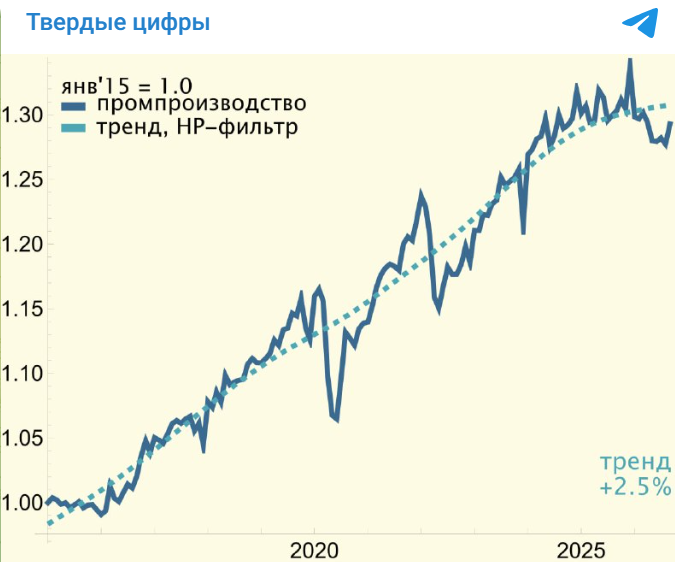
Industrial production plummeted sharply following a strong surge at the end of 2025. This is shown in the following chart from the Russian Telegram channel “Harte Zahlen,” a regular participant in the Central Bank’s analyst surveys. Through August, industrial production had declined on a seasonally adjusted basis. In September, however, according to calculations by “Hard Numbers,” it rose by 1.2% on a seasonally adjusted basis compared to the previous month. It has not yet returned to its long-term trend line, however.
Total Industrial Production Index (Jan. 2015 = 1)
Telegram channel “Hard Numbers”
Harte Zahlen: Industrial Production in September: Specific Sectors on the Rise, Oct. 28, 26
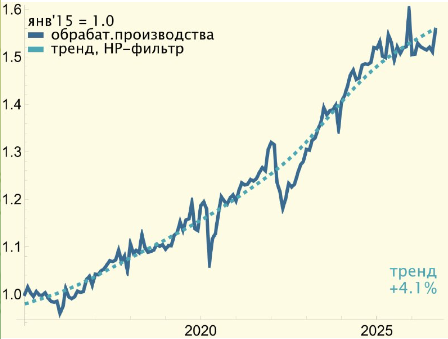
Production in the “manufacturing sector” fared significantly better than overall industrial production. The following figure shows that the “manufacturing” production index remained virtually flat from the beginning of 2026 through August. A sharp 3% increase in September compared to August has now brought the index back in line with its “trend line.”
"Manufacturing" Production Index (Jan. 2015 = 1)
Telegram channel “Hard Numbers”
Hard Numbers: Industrial Production in September: Specific Sectors on the Rise, Oct. 28, 26
The CMASF is expected to publish its monthly report on industrial production trends for September this week. It includes a comparison of the CMASF’s calculations on the seasonally adjusted trend in industrial production with Rosstat’s calculations (CMASF report for August).
How Incomes and Private Consumption Are Trending
Kommersant summarized the current trends in income and private consumption as follows:
Consumer demand strengthened significantly in September. According to estimates from the Ministry of Economic Development, total sales in retail, services, and the restaurant industry rose by 3.6% in real terms year-over-year in September, up from 2.9% in August. Annual growth rates increased in all three sectors, but most notably in the food service sector.
Retail sales rose by 3.9% in real terms year-over-year in September (+5% for the January–September period).
Indicators of private consumption and wage trends
: Year-over-year change in percent
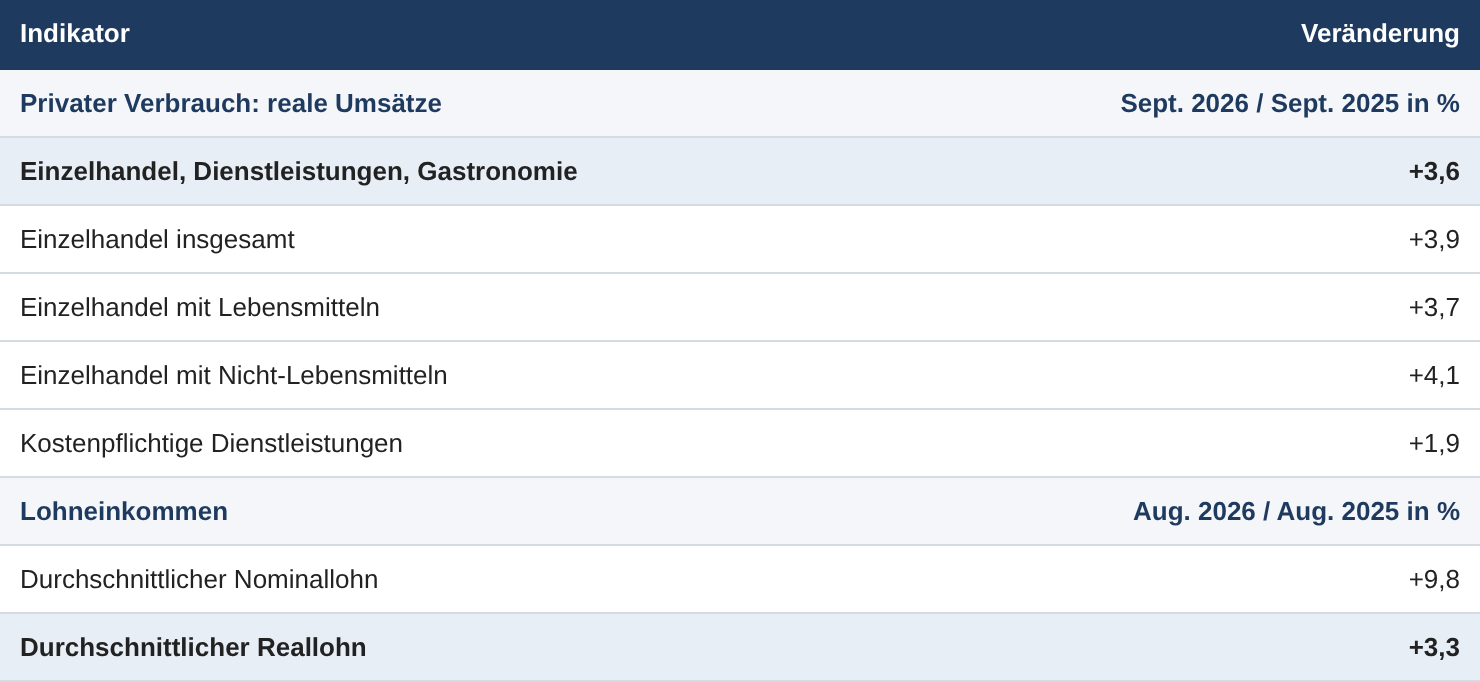
Sources: Rosstat, Ministry of Economic Development of the Russian Federation; Kommersant, Oct. 29, 26
The increase in real wages stabilized at 3.3% in August. From January through August, real wages were 5.8% higher than a year ago.
According to Rosstat, the annual growth in real disposable income accelerated from 3% in the second quarter to 3.4% in the third quarter.
Households spent the largest portion of their income on goods and services (75.2% compared with 71.6% the previous year). The share allocated to savings fell from 11.4% to 8.6%.
Raiffeisenbank: A Decline in Consumer Spending Would Be Surprising
Moscow-based Raiffeisenbank notes, regarding the current trend in private consumption indicators, that there are so far no signs of a sustained slowdown in consumer activity. In summary, the bank reports:
Consumer spending picked up again in September thanks to rising incomes.
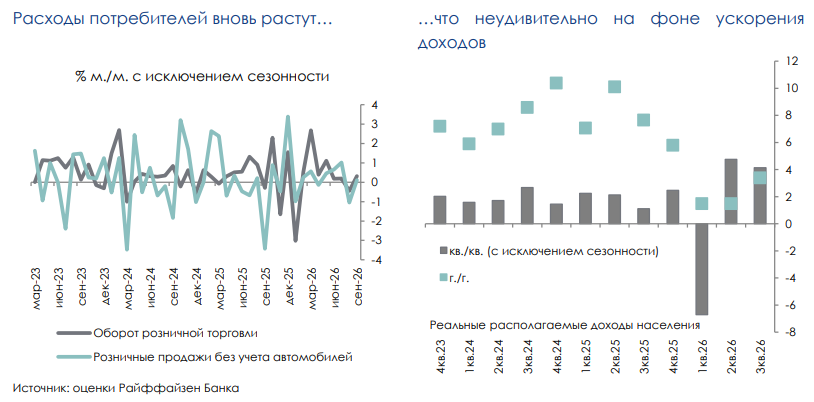
In recent months, however, there has been a slowdown in retail sales growth (and even a decline in August). In September, however, the seasonally adjusted increase in consumer spending in the retail sector reached a level of +0.3 to +0.4% compared to the previous month. This corresponds to the average growth rate of the previous year (see the dark gray line in the left-hand chart below).
At the same time, trends in individual components of consumer spending remain extremely varied. For example, in September, sales of clothing and footwear, electronics and household appliances, medications, and some food items fell for the second consecutive month.
Real disposable income rose by a solid 4% in both the second and third quarters compared with the previous quarter, after having fallen significantly in the first quarter compared with the second quarter (see the gray bars in the chart on the right).
Compared with the same quarter of the previous year, the increase in real disposable income accelerated to 3.4% in the third quarter. It was roughly twice as strong as in the first and second quarters (see turquoise squares in the chart on the right).
Retail Sales Trends and Real Disposable Income
Consumer spending is rising again (left) … which is not surprising given the accelerated income growth (right)
Raiffeisenbank: Consumer spending picked up again in September thanks to higher incomes, Oct. 30, 26
In the left-hand chart, the dark gray line shows the percentage change in seasonally adjusted total real retail sales compared to the previous month. The turquoise line shows the percentage change in seasonally adjusted real retail sales, excluding automotive sales, compared to the previous month.
In the chart on the right, the gray bars show the percentage change in seasonally adjusted real disposable income of the population compared to the previous quarter. The turquoise squares show the percentage increase in real disposable income compared to the same quarter of the previous year.
Recommended Reading
German-Russian Chamber of Foreign Trade:
- Cabinet reshuffle: four new appointments, one “superminister,” Oct. 30, 26
- Lower Profits, Expensive Loans: Russian Companies Are Investing Less, Oct. 29, 26
- Russia Open to Natural Gas Supplies; October 28, 26
- Key interest rate remains at 14%: Russian Central Bank prepares for a prolonged period of high interest rates, 10/28/26
- The number of German companies has declined, 10/23/26
- Siluanov to be granted additional powers, Oct. 21, 2026
Overall Economy (Austrian Chamber of Commerce: Russia Country Profile, as of Oct. 2026; TradingEconomics: News; Calendar; Kommersant, Vedomosti, Politkom, inveb.ru, Finam)
Economic Data for September and the Third Quarter of 2026
- russland.capital: Russia’s economy is barely growing—defense-related sectors continue to expand; Oct. 31, 26
- The Bell: The two-speed economy has once again become evident in GDP growth; Oct. 29, 26
- Finam.ru; Olga Belenkaya: September Results for the Russian Economy. Annual GDP growth slowed, while industry and consumption gained momentum; Oct. 29, 2026
- MEC, Igor Savonov: Industrial Production: A One-Time Surge, 10/29/26
- MMI: Industry in September: Record growth since the beginning of the year, 10/29/26
- bne Intellinews, Ben Aris: Russia’s GDP growth slows to 0.5% in September. The economy grew 0.6% in the third quarter, down from 1.3% in the second, as extraction, wholesale trade, and agriculture contracted; 10/29/26
- Kommersant; Artem Chugunov: The economy is slowing down. The recovery in industry and consumption in September did not accelerate GDP growth. 10/29/26
- russland.capital: Russian consumers are becoming more cautious—consumption growth is approaching zero, 10/29/26
- Der Standard; “Topic of the Day” podcast: Is Russia running out of money, Torsten Heinrich? How much longer can the Russian economy sustain war expenditures? Military historian and YouTuber Torsten Heinrich answers these questions. Video, Oct. 29, 26; Podcast: Military & History with Torsten Heinrich: Russia’s Economy Is at Its Limit, 21 min., Oct. 18, 26
- bne Intellinews, Ben Aris: Russian consumer spending growth stalls in October, October 28, 2026
- Kommersant; Artem Chugunov: Private demand continues to weaken, Oct. 28, 26
- TradingEconomics; Larissa Caser: Russia’s Industrial Activity Unexpectedly Recovers, October 28, 26
- Hard Numbers: Annual Trends in Key Macroeconomic Indicators, Oct. 28, 26
- Hard Numbers: Industrial Production in September: Specific Sectors on the Rise, 10/28/26
- Finmarket.ru: The Ministry of Economic Development estimated Russian GDP growth in September at 0.5%; Oct. 28, 26
- Production growth in key sectors of the Russian economy slowed to 0.7% in September; 10/28/26
- Industrial production in Russia rose by 1.8% in September; 10/28/26
- Net profits of Russian companies fell by 11% in the January–August period; October 28, 2026
- Salaries in Russia rose by 3.3% in August; Oct. 28, 2026
- Retail sales growth accelerated to 3.9% in September; Oct. 28, 2026
- The unemployment rate in Russia remained at 2.2% in September, Oct. 28, 2026
- TASS: Industrial production in Russia rose by 0.2% in the first nine months, 10/29/26
- TASS: Russians’ real disposable income rose by 3% in the January–September period, Oct. 28, 2026
- Interfax.ru: Russia’s GDP grew by 0.5% year-over-year in September; October 28, 2026
- Interfax.ru: Industrial production in Russia rose by 1.8% in September and by 0.2% from January through September; October 28, 2026
- Interfax.ru: Russian retail sales rose by 3.9% in September; Oct. 28, 2026
- Interfax.ru: Real disposable income for the Russian population rose by 3.4% in the third quarter; 10/28/26
- Interfax.ru: Unemployment in Russia remained at the August level in September, standing at 2.2%; Oct. 28, 2026
- German-Russian Chamber of Foreign Trade: 2027 will bring “quiet job cuts,” Oct. 27, 2026
- Frankfurter Rundschau, Marcel Reich: Putin Under Pressure: Russian Companies Owe 155 Trillion Rubles—Experts Warn of a Domino Effect, 10/27/26
- Vedomosti; Natalia Zakharova: Novak: From January to August, the economy grew by 0.6% year-over-year, Oct. 26, 2026
- The Moscow Times: Russian Businesses Delay Payments as Cash Squeeze Deepens, October 26, 2026
- BOFIT Blog; Sinikka Parviainen: Russian Households in 2025: Better Off, but Not Happier, October 8, 2026
Economic Forecasts
- CMASF: Macroeconomic Base Forecast, Oct. 30, 26
- RBC.ru: Sberbank has raised its inflation forecast and adjusted its GDP forecast. It expects GDP growth of 0.5–1% and inflation of 6.5–7.5% by the end of 2026; Oct. 28, 2026
- Bank of Russia: Medium-term forecast; October 23, 2026
- Top Leader: Economic trends in Eastern Europe are mixed and highly country-specific. wiiw: New growth model in CEE countries—positive momentum for Austria’s economy, Oct. 27, 2026
- Salzburger Nachrichten; APA: Eastern Europe continues to grow strongly despite high energy prices, Oct. 21, 2026
- Die Presse, Aloysius Widmann: Eastern Europe’s economy is booming—but debt is becoming a problem, October 21, 2026
- Vienna Institute for International Economic Comparisons (wiiw): Fall Forecast 2026; Andreas Knapp; Press Releases: English; German; Executive Summary; Richard Grieveson: Central, East, and Southeast Europe in 2027: Resilient Growth in a More Dangerous World, Oct. 21, 2026; wiiw Country Overview: Russia; Additional Press Reports: wiiw in the Press
- Bank of Russia: Macroeconomic Survey of the Bank of Russia, October 14, 2026
- International Monetary Fund, IMF: World Economic Outlook: Resilience Under Strain, Urgent Choices, October 2026; Press Briefing Transcript: World Economic Outlook, Annual Meetings 2026, October 13, 2026
- OPEC Secretariat, Vienna: Monthly Oil Market Report, October 13, 2026
- Institute for Economic Forecasting of the Russian Academy of Sciences, IEF-RAS: Short-Term Analysis of GDP Trends; October 12, 26
- World Bank: Country Report: Russian Federation, in: Macro Poverty Outlook; Europe and Central Asia Update; October 6, 2026; World Bank: Press Release; Europe and Central Asia: Slower Growth with Global Headwinds; October 6, 2026
Monetary Policy, Inflation (Central Bank calendar; Interfax reports, Kommersant reports)
- Bond Guide: Banks’ Record Profits Rest on Shaky Ground. Russian banks are reporting record profits, while non-performing loans are rising significantly. The Bell: The Central Bank apparently allows risk provisions to be too low. Oct. 31, 26
- Politkom.ru; Nikita Maslennikov: The Central Bank reiterated its “most important” priority, Oct. 29, 26
- bne Intellinews, Ben Aris: Russia’s central bank sees 14–16% interest rates in 2027 if inflation risks materialize. The final 2027–2029 monetary policy guidelines add an AI-led global crash as a possible crisis trigger and initiate a review of the 4% inflation target, Oct. 29, 26
- Bank of Russia: Monetary Policy Guidelines for 2027–2029 released, English editions: Monetary Policy Guidelines, Oct. 28, 2026
- Interfax.ru: Inflation in Russia stood at 0.08% from October 20 to 26; the annual inflation rate fell to 7.11%; October 28, 2026: Interfax.ru: Gasoline prices in Russia fell by 1.63% from October 20 to 26, while diesel prices declined by 0.05%, October 28, 2026
- CMASF Analysis: On Inflation Trends from September 29 to October 19, 2026, Oct. 27, 2026
- ntv.de; Artur Weigandt: Prices Are Rising After the Election. How Inflation Is Sweeping Across Russia, Oct. 25, 2026
- russland.capital: 14 Percent and No All-Clear: Russia’s Central Bank Postpones Hopes for an Interest Rate Cut; with a russlandTV video of the press conference; October 24, 2026
- Trend.at; APA: Russian Central Bank Keeps Key Rate High; October 24, 2026
- bne Intellinews, Ben Aris: Russia’s central bank holds key rate at 14%, raises inflation forecast; October 24, 2026
- Finam.ru; Olga Belenkaya: The Russian Central Bank left the key rate unchanged and forecasts less room for rate cuts in 2027; Oct. 23, 2026
- Kommersant; Vadim Visloguzov: The Central Bank Is in No Hurry. The Pause in Key Rate Cuts Could Be Extended; Oct. 23, 2026
- Kommersant: Meeting of the Board of Directors of the Central Bank of Russia. Key points, Oct. 23, 26
- Russian Union of Industrialists and Entrepreneurs; Press Release: Alexander Murychev: Keeping the key interest rate at 14% is an expected decision, Oct. 23, 2026
- Interfax.ru: Shokhin believes the Central Bank could symbolically cut the interest rate by 0.25 to 0.5 percentage points, 10/23/26
- TASS: Shokhin called the decision to keep the key interest rate unchanged as expected. According to the chairman of the Russian Union of Industrialists and Entrepreneurs, the Central Bank could agree to a symbolic cut of 50 or 25 basis points, October 23, 2026
- Radio “Kommersant FM”: “The trajectory of the key interest rate has changed significantly.” Alexander Isakov, chief economist at Sberbank and VEB.RF, on the Central Bank’s statements; Oct. 23, 2026
- Vedomosti; Mikhail Belyaev: How Nabiullina Explained the Decision to Keep the Key Rate Unchanged. The regulator expects inflation to reach 7.6% in 2026 and has raised its forecast for the average inflation rate; Oct. 23, 2026
- Interfax.ru: As expected, the Bank of Russia kept its key interest rate at 14%; Oct. 23, 2026; The Central Bank narrowed its forecast for Russian GDP growth in 2026 to 0.5–1.0% and lowered it to 1.0–2.0% for 2027; Oct. 23, 2026; The Russian Central Bank has raised its forecast for the average interest rate for 2027 and 2028; Oct. 23, 2026
- Moscow Times, Russian edition; Reuters: The Russian Central Bank keeps its key interest rate unchanged and hopes to bring inflation back down to 4% by 2027; Oct. 23, 2026
- Reuters – Translated by MarketScreener: Russian Central Bank leaves key rate at 14% and raises inflation forecast for 2026; Oct. 23, 2026; Reuters; Elena Fabrichnaya and Gleb Bryanski: Russian Central Bank Keeps Key Rate on Hold at 14%, Raises 2026 Inflation Forecast, Oct. 23, 2026
- Parliamentary Gazette; Julia Katenyova: The Central Bank once again kept the interest rate at 14% per year; Oct. 23, 2026
- Bank of Russia: Statement by Bank of Russia Governor Elvira Nabiullina following the Board of Directors meeting on October 23, 2026; October 23, 2026
- Bank of Russia; Press Release: Bank of Russia Keeps Key Rate at 14.00% p.a., October 23, 2026
- Bank of Russia: Medium-term forecast; October 23, 2026
Fiscal Policy; Federal Budget (Interfax Reports)
- IEF-RAS; Ksenia Evgenievna Savchishina: Review of the Draft Federal Law “On the Federal Budget for 2027 and for the Planning Period of 2028 and 2029” (in the first version submitted to the State Duma of the Russian Federation for deliberation on October 1, 2026), October 30, 2026
- ABC News; DAVID MCHUGH, DASHA LITVINOVA (AP): As the war strains the Kremlin’s finances, Putin searches for new revenue streams, Oct. 28, 2026
- United24; Illia Kabachynskyi: Russia Has No More Money to Throw at Its War in Ukraine. Its 2027 Budget Shows Why, Oct. 23, 2026
- russland.capital: Russia’s Budget: Tightening the Belt, But We Can’t Call It That; Oct. 23, 2026; Russia’s Budget: Siluanov Considers the Deficit Small—But Costs Are Rising; Oct. 21, 2026
- FR.de; Marcel Reich: Russia’s Economy Under Pressure: Kremlin Expects Budget Shortfall to Double, October 21, 2026
Energy Sector, Fuel Supply, Infrastructure (DW in Russian: Fuel Crisis)
- Focus; Lars-Eric Nievelstein: U.S.-Russia Diesel Agreement. Kremlin Lowers Oil Export Forecast to a 17-Year Low, Nov. 1, 26
- russland.capital: Russia’s Gas Remains a Factor on the World Market—Europe Faces an Expensive Farewell, Oct. 29, 26
- DW; Michael Rostand: FT: The U.S. and Russia are negotiating the return of American oil companies to Russia, October 28, 26
- Interfax.ru: The World Bank expects energy prices to rise by 32% in 2026 and fall by 12% in 2027; October 28, 2026
- The Moscow Times: Putin Warns Against Attempts to Exclude Russia From the Global Natural Gas Market, Oct. 27, 2026
- russland.capital: Russian Diesel for the U.S.: Prices Remain High, Oct. 27, 26
- Frankfurter Rundschau: First Russian Diesel Shipment to the U.S. Begins Following Trump-Putin Agreement, Oct. 23, 26
- German-Russian Chamber of Foreign Trade: Gas Agreement with China “by the End of the Year,” Oct. 23, 2026
- Focus Online, Lars-Eric Nievelstein: Russia Discovers the Arctic for Increased Oil Exports, Oct. 23, 2026
- CNN; Matt Egan: From the dark fleet to Russian diesel, there are no ‘silver bullets’ for bringing down fuel prices, Oct. 21, 26
Foreign Trade, Sanctions; Tagesschau: Sanctions Against Russia
- German-Russian Chamber of Foreign Trade: Putin: Good Conditions for Western Companies, October 27, 2026
- Merkur.de; Richard Strobl: German supermarket chain Metro donates millions to Putin for the war in Ukraine—clarification follows immediately, Oct. 26, 2026
- Tichys Einblick, Franka Haase: How Many Sanctions Will It Take for Russia to Back Down?, 10/24/26
- tagesschau.de; Jean-Marie Magro, ARD Brussels: Oil and Uranium Despite Sanctions. Europe Is Still This Dependent on Russia; Dependencies Remain, Especially for Oil and Uranium; October 24, 26
- russland.capital: Gazprom Offers Gas to Europe: Old Pipeline, New Negotiating Position, October 23, 26
- russland.capital: Ownership Depends on the Political Climate: Russia Spares U.S. Companies and Puts Pressure on Europeans. European companies are placed under state-imposed external administration in Russia significantly more often than American ones; Oct. 23, 26
- Focus online; Lars-Eric Nievelstein: Ships circumvent EU sanctions. Putin ends the game of hide-and-seek with his shadow fleets. Now the country is increasingly reflagging the ships, Oct. 23, 2026
- International Relations Review; Nicky Reich: Not So Isolated: How Russia Employs the FSU to Circumvent EU Sanctions, Oct. 22, 2026
- Tagesschau; Matthias Fuchs, WDR: Despite the split. Globus’s business with Russia continues to raise questions; Oct. 21, 26; This topic on the program: Das Erste | Plusminus | WDR; Matthias Fuchs: Why are German companies betting on the Russian market—despite the war? Oct. 21, 26
- Financial News; dts News Agency: German Companies’ Business with Russia Continues to Decline. German-Russian trade has declined significantly in many respects since February 2022; Report by the Federal Statistical Office (Destatis), October 21, 2026
- Handelsblatt, dpa: Economic relations with Russia have declined sharply; Oct. 21, 2026
- russland.capital: Russia’s foreign trade is growing—but the Central Bank needs to double-check the figures, Oct. 20, 26
- cash; Sören Premer and Dr. Tatiana Vukolova: Russia and Metro: When ownership remains, but control is lost. The forced administration of Metro’s Russian operations raises questions: How far will government intervention go? Is Russia harming its own economy? And how can European companies protect their investments? October 20, 26
Political Landscape; BR24: Russia
- t-online; Patrick Diekmann: Setbacks for Putin in Ukraine. The war takes an unexpected turn, Nov. 1, 2026
- The Economy, Tyler Hansbrough: “Europe Weary of War Costs, Russia Facing Economic Hardship”: Moves Toward Direct Western-Russian Negotiations Gain Momentum, Opening a New Phase in Talks to End the War; 10/29/26
- Merkur; Florian Naumann, interview with Māris Andžāns, director of the think tank “Center for Geopolitical Studies” in Riga: “Russia is like a zombie: It should already be dead—but it keeps on going.” During the meeting in Riga, Māris Andžāns points out the unique characteristics of Russian politics and society. “You can’t judge Russia by Western standards,” October 24, 2026
- Web.de; Analysis by Joana Rettig: Putin needs new soldiers—but he can do so without a wave of mobilization. Russia expert Gerhard Mangott considers a partial or general mobilization unlikely even in the foreseeable future; Oct. 26, 26
- German Foreign Policy: In the spiral of escalation. The spiral of escalation triggered by Ukraine’s attacks on Russian warehouses and refineries—which were applauded in Germany—is taking its toll primarily on the Ukrainian economy; wiiw’s fall forecast, Oct. 23, 2026
- Merkur; Lukas Richter: Nord Stream, EU accession, no NATO membership—this is what Washington is proposing for peace in Ukraine, Oct. 23, 26
- Nau.ch; Stephan Felder: Has Russia Already Won the War in Ukraine? Trump Meets Putin Halfway, Ukraine Struggles with Starlink Restrictions. Has Russia Won the War? Two Experts Disagree; October 23, 26
- ZDF “heute” interview with Rüdiger von Fritsch, former German ambassador to Russia: A dangerous closeness to Russia? Why the U.S.’s negotiating position is weakened; 18 min., Oct. 22, 26
The day's most important Russian economic stories. Free, in your inbox three times a week.
Mon, Wed, Fri. Double opt-in, no tracking, unsubscribe anytime. By subscribing you consent to the processing of your email address as described in our Privacy Policy.